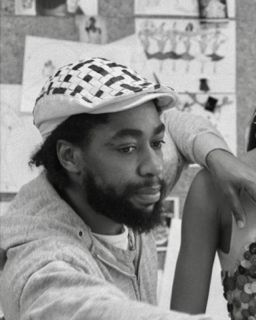
- 1954 (MCMLIV)
- 1990 (MCMXC)
- African American
- Patrick Kelly Paris
- •Button-covered dresses
- •First American (and first Black) member of the Chambre Syndicale (1988)
- •Golliwog and watermelon iconography as reclamation
Patrick Kelly
The Vicksburg, Mississippi, designer who arrived in Paris with one suitcase and became, in 1988, the first American and first Black designer voted into the French couture federation.
Patrick Kelly was born in 1954 in Vicksburg, Mississippi. He studied at Jackson State University and at Parsons School of Design in New York. He was ejected from Parsons after two semesters for lack of funds. He sold clothes at a Harlem boutique, worked as a window-dresser at Yves Saint Laurent Rive Gauche in New York, and, on a one-way ticket paid for by the model Pat Cleveland, arrived in Paris in 1979. He slept on apartment floors for the first six months.
The Paris Work
He showed his first collection informally in 1982, on the steps of a Paris metro station. He opened his own house formally in 1985 at 6 rue du Parc Royal, financed by the Warnaco Group. His signature aesthetic was a deliberate, combative embrace of visual markers that had previously been used against Black Americans: mammy figures, watermelons, golliwog pins, fried-chicken iconography, button-covered mini-dresses referencing the ribbon-and-button improvisation of rural Southern grandmothers. His invitation cards were printed with a cartoon smiling golliwog.
I design clothes for fat ladies, skinny ladies, tall ladies, short ladies, every size lady. — Patrick Kelly
The Federation
In December 1988 Kelly was formally inducted into the Chambre Syndicale du Prêt-à-Porter des Couturiers et des Créateurs de Mode, the French fashion federation. He was the first American and the first Black designer to be admitted. His induction was covered on the front page of Le Monde. He was thirty-four.
The Death
Kelly was diagnosed with AIDS-related illnesses in 1989 and died in Paris on New Year's Day 1990, at thirty-five. His twelve-year career in total produced twenty-four collections. He left an archive of sketches, press clippings, invitations, and over one hundred surviving garments.
The 2014 retrospective Patrick Kelly: Runway of Love at the Philadelphia Museum of Art, and the 2021 Metropolitan Museum acquisition of forty-one Kelly garments, have reinstated him, thirty years after his death, as one of the significant American designers of the late twentieth century.
Related Dispatches

Streetwear: How a New York Skate Shop Conquered Paris Fashion
A graphic tee from Lafayette Street, a hoodie from Harajuku, a sneaker drop announced on Instagram. The forty-year migration of skate-and-hip-hop dressing from subculture to luxury runway.

Minimalism: Why 1990s Restraint Still Defines Luxury Today
A bias-cut slip in undyed silk, a sleeveless shift in undyed wool, a bag with no logo at all. The decade that decided that subtraction was a luxury proposition — and was right.

Grunge: The Collection That Got Marc Jacobs Fired in 1992
A flannel shirt from a thrift shop, a slip dress over a Tee, a pair of Doc Martens. The Seattle-imported anti-glamour that ended one designer’s job at Perry Ellis and reordered fashion for a decade.