Grunge: The Collection That Got Marc Jacobs Fired in 1992
A flannel shirt from a thrift shop, a slip dress over a Tee, a pair of Doc Martens. The Seattle-imported anti-glamour that ended one designer’s job at Perry Ellis and reordered fashion for a decade.
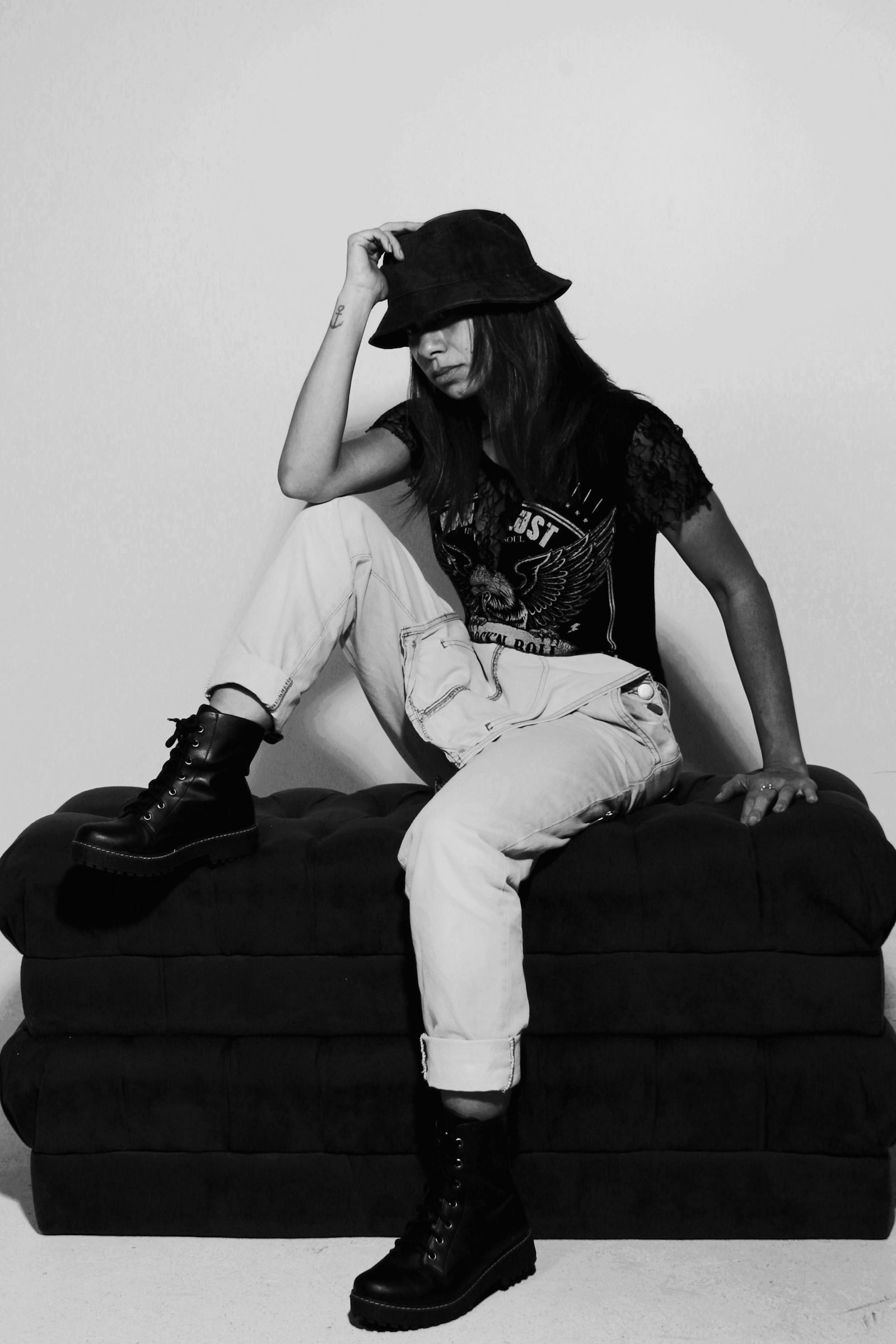
1990s Streetwear era, MCMXC–MCMXCIX
In November 1992, Marc Jacobs — then twenty-eight years old, four years into his job as the lead designer of the American sportswear house Perry Ellis — sent down a runway show in New York that was, by the standards of the company employing him, an act of professional self-immolation.
The collection was called, simply, Grunge. It comprised flannel work shirts in cotton and silk, knit beanies, slip dresses cut from satin and worn over t-shirts, ribbed cardigans, and Doc Marten boots. The clothes were photographed against a deliberately under-lit set; the soundtrack was Sonic Youth's Sugar Kane; the models, mostly young, slouched. The press was divided in real time. The New York Times's Suzy Menkes described it, famously, as garments designed for tramps. Anna Wintour reportedly walked out before the finale.
Five months later, in April 1993, Marc Jacobs was fired from Perry Ellis. The company was sold within a year. Jacobs himself, by 1997, was the head designer at Louis Vuitton in Paris.
The collection that got him fired was, in retrospect, the most influential American show of the decade. By spring 1994 every American department store had a flannel-and-slip-dress section. By 1996 the silhouette had reached the high street. By 2003 the original Perry Ellis grunge garments were appearing in major museum exhibitions. The trade publication Women's Wear Daily, ten years after the show, named it the most important American collection of the post-war period. The story of how a collection got a designer fired and then established him is, in summary, the story of the grunge movement itself.
Origins
Grunge in its musical sense — the slow, distorted, deliberately unpolished rock that emerged from the Pacific Northwest — had been gestating since 1986. The Seattle bands Mudhoney, Soundgarden, and Tad released their first records in 1988 and 1989. The label Sub Pop, founded in Seattle in 1986 by Bruce Pavitt and Jonathan Poneman, signed all three plus, in 1988, an unsigned trio called Nirvana.
The wardrobe these musicians wore on stage, off it, and in the photographs published of them in the music press — The Rocket, Backlash, Spin, eventually Rolling Stone — was specific to the Pacific Northwest in November: a thrift-shop flannel shirt over a band t-shirt, ripped Levi's, Doc Marten or military boots, a knit beanie. There was nothing aspirational about it. It was the actual wardrobe of an actual underemployed twenty-three-year-old in Olympia, Washington, in 1989, when the city's average winter temperature was 4°C and the rain was constant.
Nirvana's Nevermind was released in September 1991. By January 1992 the album had reached number one on the Billboard 200, displacing Michael Jackson's Dangerous. The video for the lead single — set in a high-school gym, with cheerleaders in plaid skirts and the band in flannel — was on continuous MTV rotation through 1992.
It is essential to the period that the figure who became the unofficial fashion icon of grunge, Kurt Cobain, was not aware of being one. The wardrobe was incidental to the music; it was wardrobing dictated by climate and budget. Its later rediscovery as a fashion proposition was, for the participants, a source of considerable irritation.
The Style
Grunge womenswear, as it codified between 1992 and 1995, had eight defining items.
The flannel shirt — thrifted from American work-wear suppliers like Pendleton, Filson, or Sears Roebuck. Worn either buttoned over a band t-shirt or, more characteristically, knotted at the waist over a slip dress.
The slip dress — satin or silk, knee-length to mid-calf, often vintage. Worn either as outerwear (over a t-shirt or a long-sleeve thermal) or directly on the body. The slip dress is the single most enduring grunge contribution to the post-decade wardrobe; it has not left.
The ripped jean — high-waisted Levi's 501s, distressed naturally rather than cosmetically. The pre-distressed jean as a retail category did not exist before 1993; by 1995 it was a major women's denim segment.
The layered t-shirt, often a long-sleeve thermal under a band t-shirt, often with a short-sleeve over both. The aesthetic argument the layers made was that no thought had gone into the dressing.
The Doc Marten boot, especially the eight-eyelet 1460. Doc Martens had been, in the 1970s and 80s, a punk and skinhead boot; their grunge re-appropriation was a third life for the silhouette.
The knit beanie, the vintage cardigan, and the band t-shirt. The cardigan was almost always thrifted, often a man's, often in beige or grey wool. The beanie was the clearest single signifier; its presence in a 1993 photograph dates the photograph to within a year.
No make-up, or no visible make-up. Hair was shaggy, often dyed in non-natural colours (Cobain's own intermittent blonde was widely emulated), often unwashed. Courtney Love, Cobain's wife and the lead singer of Hole, produced the kinderwhore sub-style: ripped tights, smeared red lipstick, baby-doll dress, intentional contradictions of childhood and sexuality. Kinderwhore was the more aesthetically articulate grunge variant.
Cultural Context
The grunge moment was, economically, a recession moment. The American GDP had contracted in 1990–91; British GDP contracted similarly. Generation X — the cohort born roughly 1965–1980, then between sixteen and twenty-six — was entering an adult labour market with the worst job-prospect ratios in postwar history. The wardrobe encoded that position. A wardrobe purchased entirely from thrift stores, totalling perhaps thirty dollars, made an explicit class statement against the conspicuous-consumption codes of the 1980s.
The cultural response was complicated by the fact that the music's audience, by 1993, had become large enough to commercialise. Nevermind sold thirty million copies. The bands were on the cover of Rolling Stone. The wardrobe, which had been the everyday clothing of a Seattle subculture, was being marketed by Bloomingdale's at three times its thrift-shop price. Cobain's response — a 1993 interview in which he complained about the situation, while wearing a thrift-store flannel — was characteristic of the contradiction. The participants knew, and minded, that they were being commodified; the commodification proceeded regardless.
The British parallel was the Britpop and indie scene of 1992–95 (Pulp, Suede, Blur, Oasis); their wardrobe overlapped with grunge but read more polished, more 1960s-coded, less Pacific Northwest. Kate Moss's 1990 The Face shoot, photographed by Corinne Day in Camber Sands, predates the American grunge moment by roughly two years and is the British origin point for what the press would later call heroin chic.
Grunge fashion's own end came swiftly. By 1996 the high-street imitations had saturated the market; by 1997 the silhouette had been displaced by minimalism (Helmut Lang, Calvin Klein) and by Tom Ford's Gucci. Cobain's death in April 1994 removed the movement's accidental centre of gravity; the bands that survived him had, by 1997, moved to other sounds and other wardrobes.
Legacy
What grunge left, beyond the slip dress and the flannel shirt, was a vocabulary for the inverse of glamour — a way for fashion to dress its own refusal. The 1990s and 2000s have been continuously occupied with this inverse. Helmut Lang's minimalism, Hedi Slimane's skinny menswear at Dior Homme (2000–07), Vetements under Demna (2014–18), Phoebe Philo's Céline, the Hadid-and-Jenner Instagram-coded normcore of 2014–18: each of these is, structurally, a grunge descendant. The argument that the visible refusal of effort is itself a luxury proposition was made first by grunge.
The slip dress in particular has not left the runway in three decades. It appears in every major designer's spring collection across the 2010s and 2020s; it has been re-photographed, re-styled, and re-priced continuously. The 1992 Marc Jacobs collection itself has been displayed in the Costume Institute at the Metropolitan Museum (2013), at the Musée des Arts Décoratifs in Paris, and at the Fashion Institute of Technology archive. Its current collector value is among the highest of any 1990s American fashion product.
The collection that got me fired was the collection that, twenty years later, kept getting me hired. — Marc Jacobs, in interview, 2013
The Marc Jacobs himself, four months after his Perry Ellis dismissal, signed with LVMH; he ran Louis Vuitton from 1997 to 2013, building it from a luggage maker into a fashion house. His own line, founded in 1985, became one of the largest American fashion brands of the 2000s. The Perry Ellis grunge collection of 1992 is, by every commercial measure, the most consequential firing in twentieth-century American fashion.
Related Reading
- Vivienne Westwood — the punk antecedent that grunge inherited.
- Helmut Lang — the Vienna-trained minimalist whose 1993–97 collections completed grunge's transition into mainstream luxury.
- The 1990s Streetwear era — the decade's wider context.
Sources & Further Reading
- Andrew Bolton and Harold Koda, Grunge: A Decade of Fashion (Metropolitan Museum of Art, 2013).
- Charles R. Cross, Heavier Than Heaven: A Biography of Kurt Cobain (Hyperion, 2001).
- Vivien Goldman, Revenge of the She-Punks (University of Texas, 2019) — for the parallel female grunge.
- Marc Jacobs's own retrospective notes from his 2013 Wall Street Journal interview.
- The archive of Sub Pop magazine, 1986–1994.

Ivo Marchetti
Writer and dress historian. Ivo contributes regularly on menswear, subculture, and the economics of style.
Related Dispatches
Streetwear: How a New York Skate Shop Conquered Paris Fashion
A graphic tee from Lafayette Street, a hoodie from Harajuku, a sneaker drop announced on Instagram. The forty-year migration of skate-and-hip-hop dressing from subculture to luxury runway.

Minimalism: Why 1990s Restraint Still Defines Luxury Today
A bias-cut slip in undyed silk, a sleeveless shift in undyed wool, a bag with no logo at all. The decade that decided that subtraction was a luxury proposition — and was right.
Power Dressing: How Women Weaponized Clothes to Break the Glass Ceiling
A skirt suit with a shoulder pad, a silk blouse with a tied bow, a structured leather handbag carried into a 1985 boardroom. The decade in which women turned the office wardrobe into a uniform of intent.
Readers’ Letters
Submissions are moderated, as in any decent publication.
No letters received yet. Yours may be the first.