
- 1923 (MCMXXIII)
- 2016 (MMXVI)
- French
- Balenciaga, Courrèges
- •The miniskirt (1964, disputed with Quant)
- •White go-go boots
- •Space Age collection (1964)
- •Geometric cut-outs
André Courrèges
The Pyrenean engineer who trained under Balenciaga, broke away in 1961, and in 1964 introduced a collection so aggressively modern that Paris, for a season, did not know what to do with it.
André Courrèges was born in 1923 in Pau, in the French Pyrenees. He trained as a civil engineer before entering couture, apprenticed at Jeanne Lafaurie, and spent eleven years (1950–61) in Balenciaga's atelier, where he rose to chief assistant. In 1961 he opened his own house with his wife Coqueline at 48 avenue Kléber.
The 1964 Collection
His Spring 1964 Moon Girl collection is among the most-cited Paris shows of the twentieth century. It presented: a knee-short pinafore, below-the-knee then mid-thigh hemlines, white vinyl flat-heel boots, white-framed wrap-around sunglasses, trouser suits cut straight from the shoulder, and geometric cut-outs in saturated white. The collection was accused, simultaneously, of being infantile and of being brutal. WWD called it "the first collection since Dior that has changed the silhouette." It was.
I do not design for grandmothers. — André Courrèges
The Miniskirt Dispute
The question of who invented the miniskirt — Mary Quant on the King's Road in 1962 or Courrèges in Paris in 1964 — has been litigated for sixty years. Quant was first to sell the silhouette commercially; Courrèges was first to bring it to couture. Both are, accurately, credited. Courrèges himself insisted, "I am the man who invented the miniskirt. Mary Quant only commercialised the idea." The claim is partly correct.
The Ready-to-Wear
In 1967 Courrèges launched Couture Future, a ready-to-wear line distributed through department stores — one of the earliest licensed diffusion lines from a Paris couturier, pre-dating YSL's Rive Gauche by a few months (timing disputed). The brand diversified through the 1970s into menswear, accessories, fragrances, and an eyewear licence.
Decline and Revival
Courrèges withdrew from the couture calendar in 1985. He suffered from Parkinson's disease from the 1990s onward and handed operations to Coqueline and to his students. He died in Neuilly-sur-Seine in 2016. The label was acquired in 2018 by Artemis Group and has been run since 2020 by Nicolas Di Felice, whose recent collections have restored the house to international buyer attention.
Related Dispatches

Mod: How British Teenagers Killed Parisian Fashion in the 1960s
Carnaby Street, the Vespa, a geometric mini, a bob cut to the jawline. The youth-culture uprising that, for the first time in fashion history, dictated the terms to Paris.
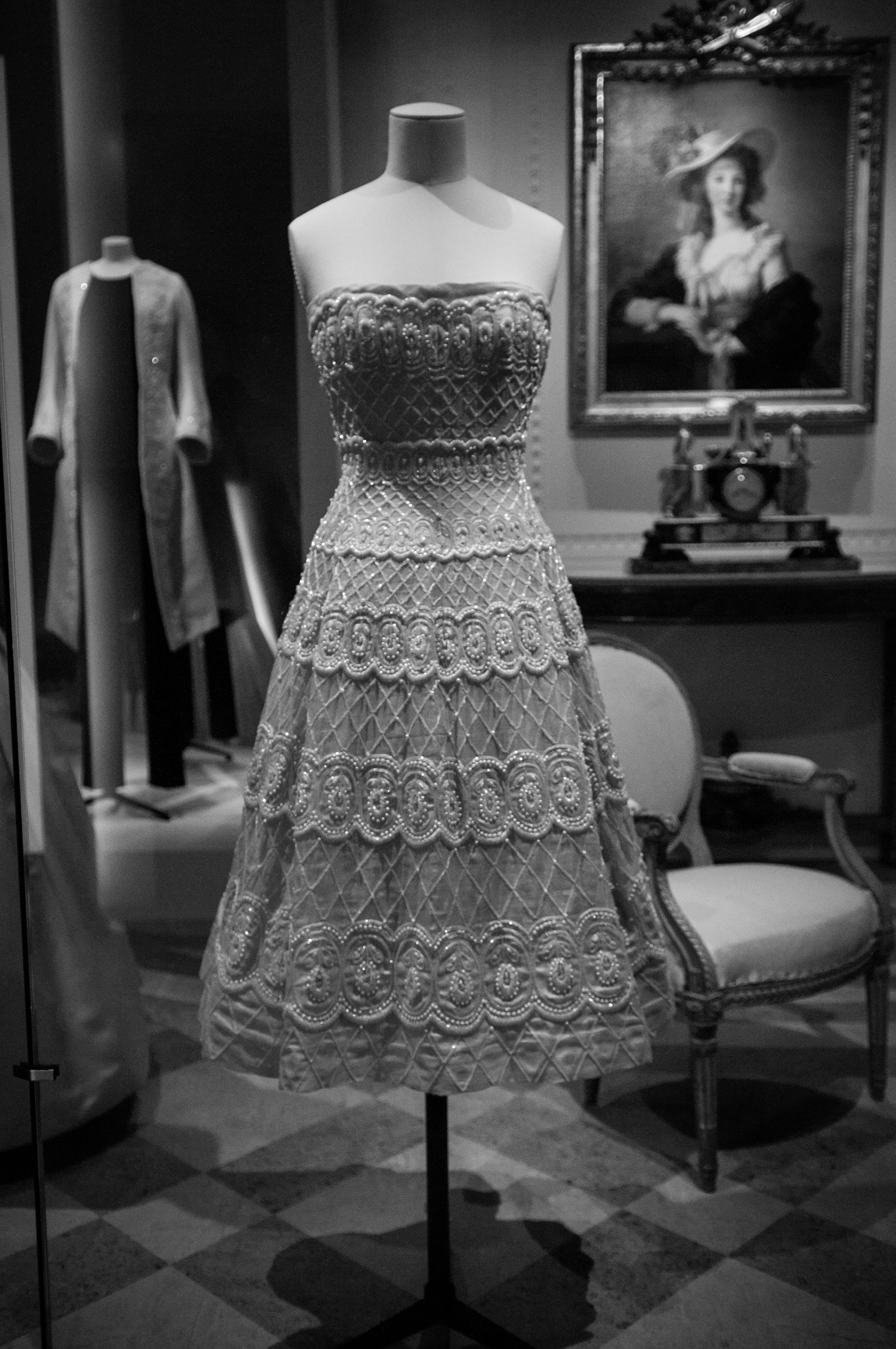
The New Look: Why Women Rioted Over a Dress in 1947
Christian Dior’s February 1947 collection used twenty yards of fabric per skirt at a moment when British women were rationed to two. The reaction was adoration, fury, and an industry rebuilt overnight.
Le Smoking: Yves Saint Laurent Dresses Women in Tuxedos
In August of 1966, an evening tuxedo appeared on a Paris runway. The model was a woman. The century shifted, quietly, on its heel.