The New Look: Why Women Rioted Over a Dress in 1947
Christian Dior’s February 1947 collection used twenty yards of fabric per skirt at a moment when British women were rationed to two. The reaction was adoration, fury, and an industry rebuilt overnight.
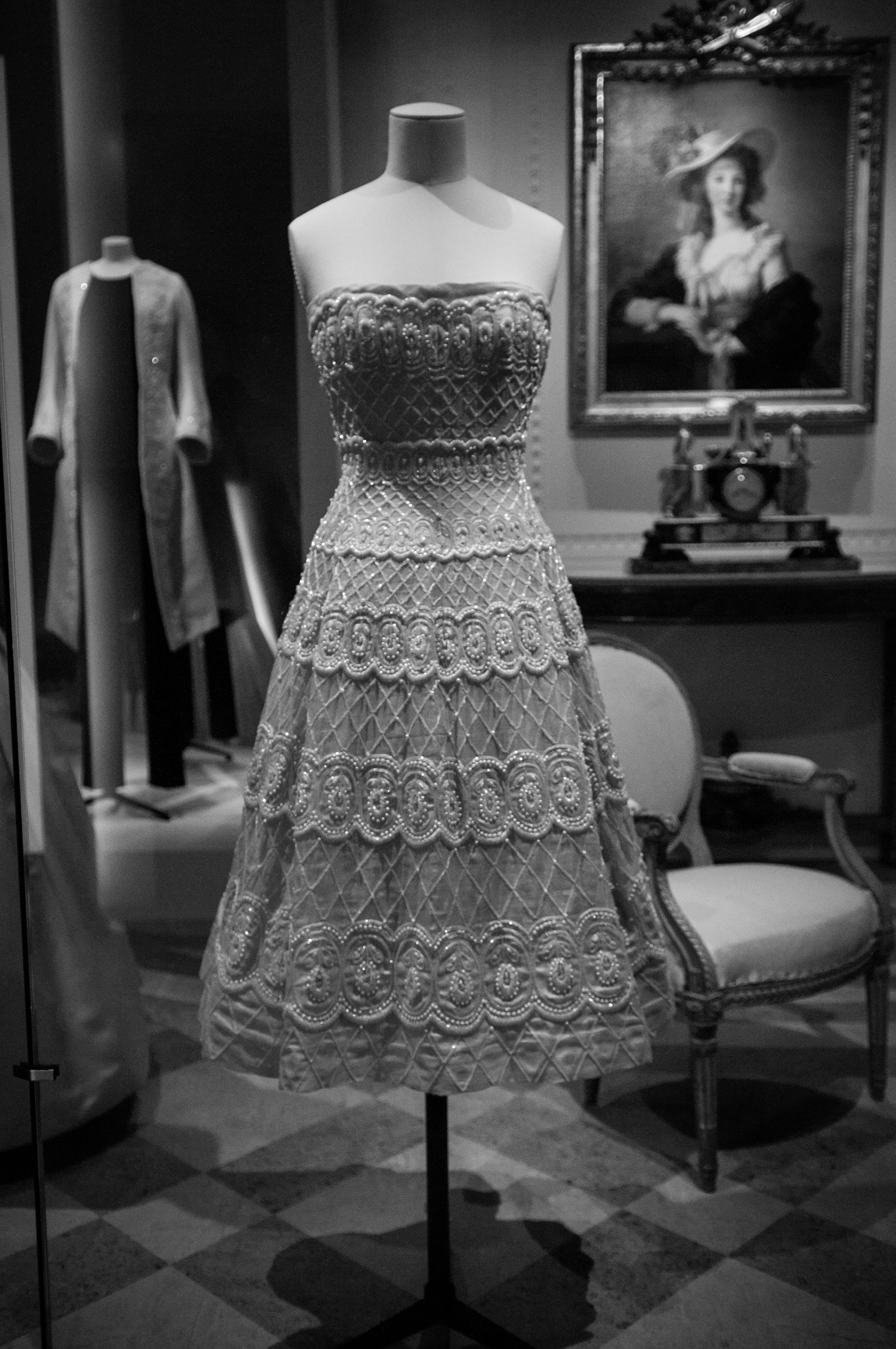
1950s New Look era, MCMXLVII–MCMLIX
On the morning of 12 February 1947, Christian Dior, a forty-two-year-old former art dealer, presented his first collection in a converted town-house on the Avenue Montaigne. The collection had two lines, Corolle and En Huit, and ninety models. Within ninety minutes the editor of Harper's Bazaar, Carmel Snow, had stood up and said, in English, what would become the title of the entire decade that followed:
It's such a New Look.
By that afternoon the phrase was on the wires to New York. By Monday it was in print. Within a year, the New Look had reorganised the global wardrobe, ended the wartime utility silhouette, set off riots in two American cities, prompted parliamentary debate in London, and put the seven-year-old House of Dior on a path to becoming, by 1950, the largest couture house in the world.
The collection itself — cinched waist, padded hip, full skirt to mid-calf, bare shoulder, wide-brimmed hat — was the most influential single show in twentieth-century fashion. It also caused, in its first year, more public anger than any garment since the introduction of trousers for women in the 1850s.
Origins
To understand why a dress could cause a riot, one has to understand what the dress was a reaction against.
The Second World War had ended in May 1945. Europe in 1947 was rationed, exhausted, and, in much of the continent, physically destroyed. Fabric was strictly controlled. In Britain, the wartime utility scheme (Civilian Clothing Order CC41, introduced 1941, still in force in 1947) regulated everything: the number of buttons on a jacket (three), the number of pleats in a skirt (two), the depth of a hem (six inches), and — critically — the total yardage permitted per garment. American wartime regulation L-85 had imposed similar rules from 1942.
The wartime silhouette was, by necessity, austere: knee-length skirt, narrow shoulder padded slightly to imitate a uniform, square-cut jacket, minimal trimming. Women had worn it for six years. They were, by 1947, very tired of it.
What Dior offered was its complete inverse. His Bar suit — the most-photographed garment of the collection — had a jacket of natural shantung silk, fitted to the bust, peplum'd at the hip with horsehair stiffening to project the silhouette outward by four inches. The skirt beneath was black wool, knife-pleated, hemmed at mid-calf, and used fifteen yards of fabric. A British utility skirt of 1947 was permitted two and a half yards.
I designed clothes for flower-like women, with rounded shoulders, full feminine busts, and tiny hand-span waists above enormous spreading skirts. I have, in effect, brought back the architecture of the body. — Christian Dior, Christian Dior et Moi, 1956
The collection was financed by Marcel Boussac, a French textile magnate who had identified Dior — then designing under Lucien Lelong — as the talent most likely to revive the post-war French silk industry. Boussac's logic was crude and brilliant: a silhouette that used a great deal of fabric per garment was, for a fabric maker, the most lucrative possible silhouette to popularise. He was correct. By 1949, Boussac's mills were running at three shifts.
The Style
The New Look's anatomy can be reduced to four elements.
The shoulder was natural, rounded, and unpadded — the precise opposite of the wartime square shoulder. Often the shoulder was bare, in the décolleté evening gowns; in day suits, the jacket curved gently over the deltoid in soft set-in sleeves.
The waist was severely cinched. Many of the day suits were worn over an guêpière — a French wasp-waist corset that compressed the waist by between two and four inches. Models were often hired specifically for their natural waist measurement (Dior preferred a 47–centimetre waist, or about 18.5 inches).
The hip was projected. This was the technical innovation. Dior's atelier, under his head technician Marguerite Carré, used horsehair, taffeta, and stiffened linen to construct internal hip projections that pushed the silhouette outward at the high hip and gave the skirt its characteristic corolle shape (a corolla — the rounded outer petals of a flower).
The skirt was full, mid-calf, and made of a great deal of cloth. The standard Corolle skirt used twelve to twenty yards of fabric depending on the model. The En Huit line was narrower — a draped sheath in a figure-eight shape — but even at its narrowest used six yards.
The accessories codified the period: long gloves, peep-toe pumps, wide picture-hats often of black straw, a single strand of pearls. By 1949, every haute couture house in Paris had adopted some version of this silhouette, and the women of the international upper class — the Duchess of Windsor, Wallis Simpson, Bettina Ballard, the Begum Aga Khan — wore it almost exclusively until 1955.
Cultural Context
The reaction outside Paris was not adoration.
In Chicago, September 1947, the Little Below the Knee club picketed a department store demonstration of the silhouette; their slogan was The Alamo had more than 184 against it; we will fight to the death for the FREEDOM OF OUR KNEES. Photographs of women carrying placards reading DOWN WITH DIOR ran in Life magazine.
In Dallas, the same month, a New Look fashion show was disrupted by women wearing knee-length skirts and shouting Burn, Mr Dior, burn!. The photos travelled.
In Britain, the trade minister Sir Stafford Cripps denounced the silhouette in the House of Commons in October 1947 as "irresponsible at a moment of national crisis", on the grounds that it would set off a black market in textile imports. (It did.) The British couturiers — Norman Hartnell, Hardy Amies, Digby Morton — were specifically forbidden from showing the silhouette at the Incorporated Society of London Fashion Designers' November 1947 collections; most ignored the order.
In France, where rationing of textiles continued until 1949, women queued in the rue Saint-HonorÉ for fittings.
The argument against the New Look was an economic and moral one. It was wasteful. It used multiple times the amount of fabric that wartime regulation permitted, at a moment when fabric was still scarce. It was, in critics' framing, an aristocratic re-imposition of pre-war values — a return to the pre-1939 idea of the woman as decorative object, after six years in which women had operated factories, driven ambulances, broken codes at Bletchley Park, and run households alone.
The argument for the New Look, less articulate but ultimately more powerful, was that those six years had been brutal, and that women were entitled to want something other than utility. Carmel Snow's "It's such a New Look" was, in this reading, a sentence of relief.
By 1949 the argument was over. The silhouette had won. Rationing in Britain ended in 1949 (textiles) and 1954 (food), and as it ended, the New Look spread to every level of the high street. The post-war American department-store boom was, in commercial fact, a New Look boom: Bonwit Teller, Bergdorf, Marshall Field's, and Saks Fifth Avenue all rebuilt their inventory around the silhouette in 1948.
Key Figures
The collection was Dior's, but it was made by an atelier of forty-two seamstresses under Marguerite Carré, who had previously been première at Patou; the technical innovation — the internal hip projection that gave the corolle its shape — was hers. The financing was Marcel Boussac's. The naming was Carmel Snow's.
The silhouette was photographed, and made photogenic, by Richard Avedon for Harper's Bazaar (the famous Dovima-with-elephants picture is from 1955) and by Henry Clarke for Vogue Paris. Its model bodies — in particular Renée Breton and Sylvie, Dior's two house mannequins — became, briefly, the most photographed women in Europe.
Its successors were swift. Cristóbal Balenciaga, in his 1947 collection, presented his own response — the barrel line, less hour-glass, less constructed, more architecturally severe; he would, by the late 1950s, have eclipsed Dior as the more original couturier of the decade. Hubert de Givenchy opened his own house in 1952 with a softer, more youthful adaptation. Pierre Balmain offered a regal interpretation. By 1955 every Paris house had a New Look line in its archive.
Legacy
Christian Dior died of a heart attack in October 1957, ten years and seven months after the original show. His house, then run by Yves Saint Laurent at the age of twenty-one, would within a year break with the silhouette — Saint Laurent's Trapeze line of 1958 was a deliberate softening, a movement toward what the 1960s would call the youthquake shape.
But the silhouette did not die when Dior did. It re-appeared, with each successive turn of taste, as a stable referent: in the 1980s of John Galliano's first couture collections at Givenchy and then at Dior itself; in McQueen's autumn 1995 The Hunger with its severe waists; in Sarah Burton's wedding dress for the Duchess of Cambridge in 2011 (a direct quotation of the Bar suit's silhouette); in Maria Grazia Chiuri's couture every season since 2017 at Dior.
The longer legacy is structural. The New Look established the post-war business model of the international couture house: financed by a textile or perfume conglomerate, marketed through a single charismatic designer, photographed by a fashion press that had been built specifically to amplify it, and licensed downward through ready-to-wear, perfume, and accessories at every price point. Every contemporary luxury house — Saint Laurent, Chanel under Lagerfeld, Versace, Valentino, Armani, the contemporary LVMH portfolio — is, in its commercial structure, a Dior in 1947. Dior was the original.
The New Look made me. It also made the modern fashion industry. — Marcel Boussac, in a 1968 interview
What it left to the body, finally, was the cinched waist. After 1947, for the next decade, women re-corseted themselves — voluntarily, en masse, and in numbers that the Aesthetes of 1880 would not have believed possible. The silhouette ended only when, in 1965, Mary Quant's mini and André Courrèges's space-age collections refused to be cinched at the waist at all. That refusal, when it came, was the sharpest break with the New Look. It was also, in scale, smaller than the New Look had been.
Related Reading
- Christian Dior — the man, the house, the ten-year reign.
- Cristóbal Balenciaga — the Spaniard whose 1947 was a colder, more architectural answer.
- The 1950s New Look era — the decade Dior named.
- Le Smoking — the silhouette’s eventual successor, and refusal.
Sources & Further Reading
- Christian Dior, Christian Dior et Moi (Amiot-Dumont, 1956). Translated by Antonia Fraser as Dior by Dior (V&A Publishing, 2018).
- Marie-France Pochna, Christian Dior: The Man Who Made the World Look New (Arcade, 1996).
- Andrew Bolton and Harold Koda, Christian Dior (Metropolitan Museum of Art, 1996).
- Florence Müller, ed. Christian Dior: Designer of Dreams (V&A Publishing, 2019).
- Archives of Harper's Bazaar and Vogue Paris, February–May 1947.

Ivo Marchetti
Writer and dress historian. Ivo contributes regularly on menswear, subculture, and the economics of style.
Related Dispatches

Streetwear: How a New York Skate Shop Conquered Paris Fashion
A graphic tee from Lafayette Street, a hoodie from Harajuku, a sneaker drop announced on Instagram. The forty-year migration of skate-and-hip-hop dressing from subculture to luxury runway.
Minimalism: Why 1990s Restraint Still Defines Luxury Today
A bias-cut slip in undyed silk, a sleeveless shift in undyed wool, a bag with no logo at all. The decade that decided that subtraction was a luxury proposition — and was right.

Grunge: The Collection That Got Marc Jacobs Fired in 1992
A flannel shirt from a thrift shop, a slip dress over a Tee, a pair of Doc Martens. The Seattle-imported anti-glamour that ended one designer’s job at Perry Ellis and reordered fashion for a decade.
Readers’ Letters
Submissions are moderated, as in any decent publication.
No letters received yet. Yours may be the first.