
- 1905 (MCMV)
- 1957 (MCMLVII)
- French
- Dior
- •The New Look (1947)
- •The Bar suit
- •Miss Dior perfume (1947)
Christian Dior
Granville, 1905. An art dealer, a cartoonist, a couturier; the man who rebuked wartime rationing with a twenty-metre skirt and reopened Paris to the world.
Christian Dior was born in 1905 in Granville, Normandy, the second child of a prosperous fertiliser manufacturer. He studied political science at Sciences Po, ran an art gallery in the 1920s — showing Dalí, Giacometti, and Calder — and, when the family fortune collapsed in 1931, paid the rent by selling fashion sketches to Parisian couturiers.
He was 41 when he opened his own house, financed by the textile magnate Marcel Boussac, at 30 Avenue Montaigne. His debut collection, on February 12, 1947, was the Corolle line, later renamed by the editor Carmel Snow as the New Look.
The Silhouette
The New Look re-engineered the feminine body after five years of wartime rationing. The shoulders were soft; the bust rounded; the waist nipped to eighteen inches with an internal corselette; the skirt a calf-length bell consuming up to twenty metres of fabric. In London, where rationing continued, housewives picketed. In New York, Dior landed on the cover of Life within six months.
I designed flower-like women, with rounded shoulders, full feminine busts, and hand-span waists above enormous spreading skirts.
The Short Reign
Dior lived ten years after that February morning. He introduced a new silhouette with nearly every collection — the Zig-Zag line (1948), the Vertical (1950), the A-line (1955) — and exported them, through a licensing empire unprecedented in couture, to dozens of countries. At his death, in 1957, of a heart attack at the spa town of Montecatini, the House of Dior accounted for five percent of all French export revenue.
Succession
He left the house to a 21-year-old assistant named Yves Saint Laurent. Saint Laurent’s first collection, the Trapeze line of 1958, was a triumph; his second, which attempted to soften the silhouette toward Beatnik Paris, was a failure; he was conscripted into the Algerian war in 1960 and dismissed from Dior during his service. The house passed to Marc Bohan, then Gianfranco Ferré, then John Galliano, then Raf Simons, then Maria Grazia Chiuri. Each cites, in each collection, the 1947 morning.
Related Dispatches

Mod: How British Teenagers Killed Parisian Fashion in the 1960s
Carnaby Street, the Vespa, a geometric mini, a bob cut to the jawline. The youth-culture uprising that, for the first time in fashion history, dictated the terms to Paris.
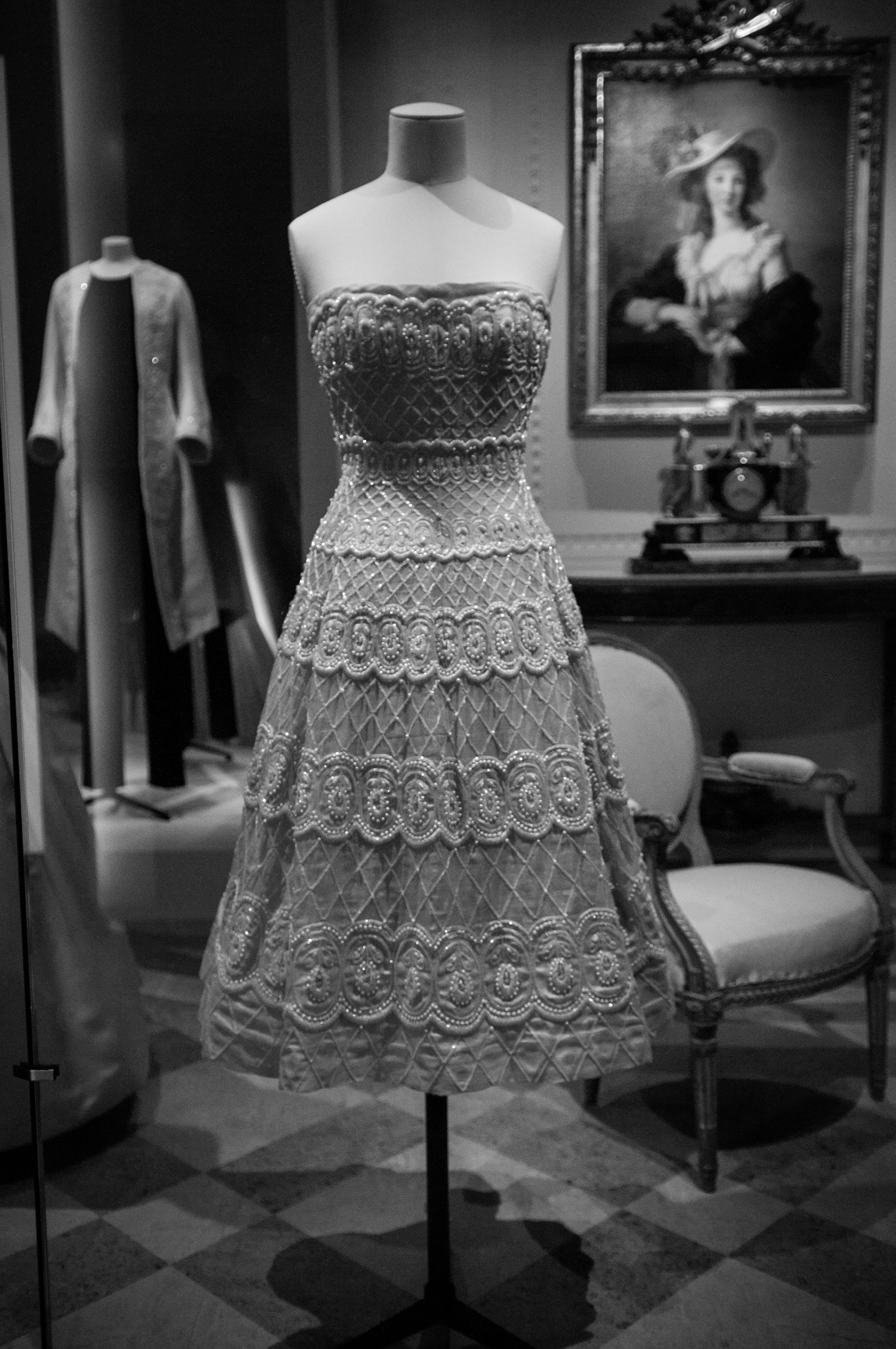
The New Look: Why Women Rioted Over a Dress in 1947
Christian Dior’s February 1947 collection used twenty yards of fabric per skirt at a moment when British women were rationed to two. The reaction was adoration, fury, and an industry rebuilt overnight.

Le Smoking: Yves Saint Laurent Dresses Women in Tuxedos
In August of 1966, an evening tuxedo appeared on a Paris runway. The model was a woman. The century shifted, quietly, on its heel.