
France
The cradle of haute couture.
If modern fashion has a birthplace, it is Paris. From Charles Frederick Worth's invention of haute couture in 1858 to Dior's New Look in 1947 and the conceptual upheavals of the 21st century, no city has shaped what the world wears more thoroughly. France did not only produce designers; it produced the idea of designers — named, signed, authored garments. It remains the world's fashion clearing house.
The Cradle of Couture
Before Paris, a dress was made by a dressmaker. A woman went to a seamstress, described the garment she wanted, and received an anonymous object. There was no author. There was no name on the label. There was, in the modern sense, no designer.
Then, in 1858, an English draper named Charles Frederick Worth opened a salon on the rue de la Paix and did something extraordinary. He sewed his name into the garments he made. He held a presentation, in advance, of a collection he had imagined; he sold that collection to clients who came to him, not the other way round. In a single decade he converted the dressmaker from a servant into an artist, and in doing so he invented the profession that would dominate women's wardrobes for a century and a half. Modern fashion was born in Paris, in French, and it has never entirely lost either.
From Poiret to the Occupation
The first fifty years of French couture were the great age of the silhouette. Paul Poiret, in 1910, abolished the corset and replaced it with the hobble skirt, the lampshade tunic, and an Orientalist vocabulary borrowed from the Ballets Russes. Madeleine Vionnet, in the 1920s, perfected the bias cut — a technical innovation so demanding that only six couturiers alive today can replicate it at her standard. Gabrielle "Coco" Chanel, a milliner from Saumur, removed what remained: the boning, the underpinning, the frippery. She put women into jersey, collarless jackets, and costume pearls worn in the daytime, and she paid for the whole operation with a bottle of perfume called N°5.
Paris was, by the 1930s, both the commercial capital of Western fashion and its aesthetic laboratory. The German Occupation nearly ended all of it. For four years, 1940 to 1944, the industry survived on an emergency footing — Lucien Lelong, head of the Chambre Syndicale, successfully resisted a Nazi plan to relocate couture to Berlin and Vienna.
The New Look and After
Christian Dior's February 1947 debut changed what Paris was for. The Corolle line — renamed the New Look by the editor Carmel Snow — used twenty yards of fabric per skirt in a city still on ration cards. It was a deliberate, almost theological, refusal of wartime scarcity. It reopened the American market to French exports and restored Paris, overnight, as the dress capital of the world.
The houses that followed — Givenchy, Cardin, Courrèges, Saint Laurent — inherited Dior's economic settlement but not his romanticism. Saint Laurent in particular rewrote the vocabulary for the twentieth century: the pea coat, the safari jacket, the trouser suit, and, in 1966, Le Smoking — the tuxedo that gave women, for the first time, formal evening dress of their own. André Courrèges, in the same decade, put them in a space-age mini. By 1970, the French couture house was no longer a salon but a multinational business with licensed fragrance, ready-to-wear diffusion, and a brand value measured in hundreds of millions of francs.
The Contemporary Moment
If the twentieth century belonged to French founders, the twenty-first has been the age of the French curator. The great historic houses — Chanel, Dior, Louis Vuitton, Balenciaga, Saint Laurent, Givenchy — are now run by a rotating cast of foreign-born creative directors, most of them trained in Belgium, Italy, or the UK. Karl Lagerfeld ran Chanel from 1983 to 2019. Nicolas Ghesquière, one of the few French-born holders of a major French house, presides over Louis Vuitton. Demna (Georgian) directs Balenciaga.
What remains distinctively French is not the nationality of the author but the scale and seriousness of the atelier. Couture, in the strict legal sense — ateliers capable of making a garment to measure for a single client, entirely by hand, with a minimum staff of fifteen — is still a Parisian privilege. The Chambre Syndicale maintains the designation. Twenty-odd houses hold it. Most of them are still in France.
The language of twentieth-century dress was written in this country. The language of twenty-first century luxury — still, despite everything, is too.
France’s Designers, in Order of Arrival
Reading from past to present, with cultural context interleaved between the portraits.
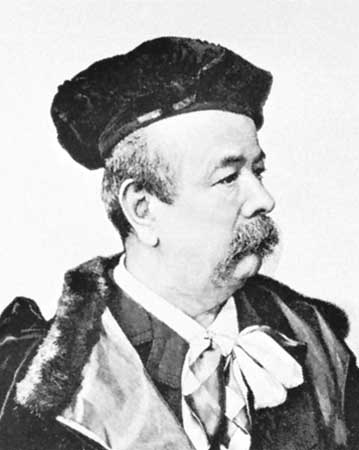
Charles Frederick Worth
The fashion house as institution
The Englishman in Paris who, in 1858, invented the modern couture house: signed labels, seasonal collections, live mannequins, and the designer as author.
English-born; founded modern French haute couture in Paris, 1858.
Read full profile →
Jeanne Lanvin
The robe de style
The milliner’s apprentice who founded, in 1889, the oldest continuously-operating French couture house — and dressed her daughter into the century’s most famous logo.
Read full profile →
Madeleine Vionnet
The bias cut
The mathematician of cloth. The Burgundian seamstress who rotated the fabric forty-five degrees and discovered the body.
Read full profile →
Paul Poiret
Abolition of the corset (1906)
The Parisian who freed the female torso from the corset before Chanel did, and dressed the 1910s in kimonos, turbans, and a scandalous saturation of colour.
Read full profile →
Gabrielle "Coco" Chanel
The little black dress
The milliner from Saumur who replaced the corset with jersey, the waist with a straight line, and the twentieth-century woman with herself.
Read full profile →
Jean Patou
Sportswear as couture
The Norman tanner’s son who dressed the tennis player Suzanne Lenglen in pleated white and launched, in 1930, the most expensive perfume in the world.
Read full profile →
Christian Dior
The New Look (1947)
Granville, 1905. An art dealer, a cartoonist, a couturier; the man who rebuked wartime rationing with a twenty-metre skirt and reopened Paris to the world.
Read full profile →
Pierre Cardin
Space Age collection (1964)
The tailor’s son from Venice who dressed the 1960s in vinyl and geometry, and then sold his name to 800 products in 94 countries.
Italian-born; built his house in Paris from 1950 onward.
Read full profile →
André Courrèges
The miniskirt (1964, disputed with Quant)
The Pyrenean engineer who trained under Balenciaga, broke away in 1961, and in 1964 introduced a collection so aggressively modern that Paris, for a season, did not know what to do with it.
Read full profile →
Hubert de Givenchy
The Bettina blouse (1952)
The Beauvais aristocrat who, at twenty-five, opened the simplest house in Paris — and dressed the twentieth century’s most photographed woman.
Read full profile →
Yves Saint Laurent
Le Smoking (1966)
Oran, 1936. The couturier who introduced the tuxedo to women’s wardrobes and ready-to-wear to Parisian couture.
Born in Oran, French Algeria; worked entirely in Paris.
Read full profile →
Nicolas Ghesquière
Balenciaga’s 1997–2012 revival
The Loudun-born designer who took over a nearly-closed Balenciaga at twenty-six, rebuilt it in fifteen years, and has run Louis Vuitton womenswear since 2013.
Read full profile →
Demna Gvasalia
Vetements DHL T-shirt (2016)
The Sukhumi-born refugee who co-founded Vetements and, at thirty-four, took over Balenciaga. He moves to Gucci in 2026.
Georgian-born (Demna Gvasalia); creative director of Balenciaga in Paris.
Read full profile →