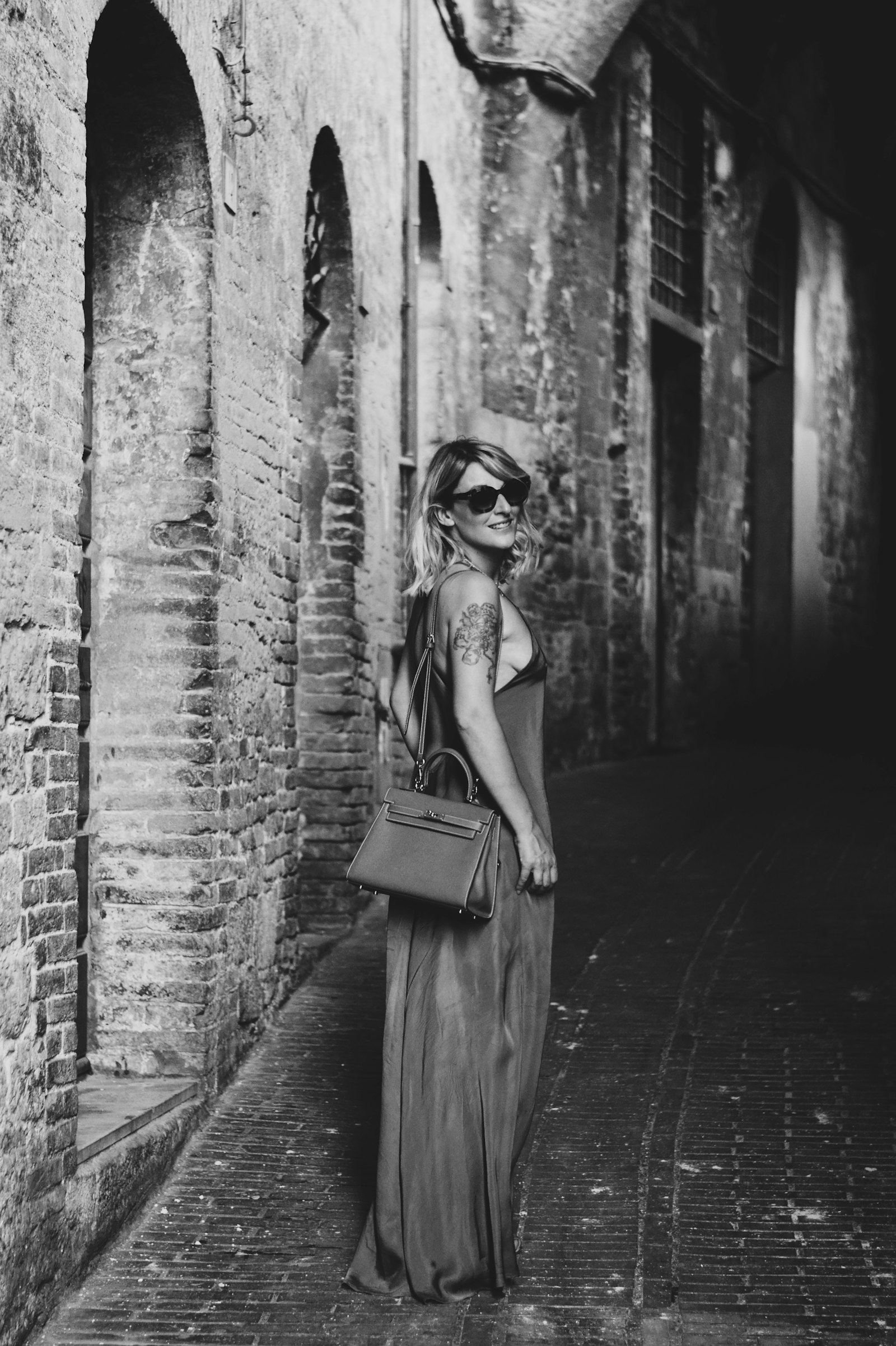
Italy
Where craftsmanship meets glamour.
Italian fashion is the art of construction. From Mariano Fortuny's Venetian pleats to the post-war Sala Bianca shows in Florence to the Milan ready-to-wear revolution of Armani and Prada, Italy's contribution to global dress has always been tactile: cloth, cut, craft. If France invented couture, Italy built the factory that could make it scale.
The Workshop of Europe
Italian fashion begins, like so much of Italian art, in the workshop. The country's unique contribution to twentieth-century dress is not a silhouette or a movement but a method — the small, regional, family-run factory capable of executing couture at ready-to-wear scale. Before Milan could become the world's second fashion capital, Italy had to build the supply chain that would feed it.
The earliest named Italian designer of the modern era is Mariano Fortuny, a Spanish-born painter working out of a Venetian palazzo. In 1906 he patented the Delphos gown — a finely pleated column of silk inspired by Greek statuary — and produced it, by hand, for forty years. Fortuny showed that Italy could author a garment, not only manufacture one.
The Sala Bianca and the Post-War Miracle
The birth of Italian fashion as an industry, however, is usually dated to 12 February 1951, when the Florentine promoter Giovanni Battista Giorgini staged the first collective presentation of Italian collections in the Sala Bianca of the Palazzo Pitti. Ten houses showed to an audience of American department-store buyers. The timing was perfect: Paris was exhausted from the war, American buyers were cash-rich, and Italy had both superb textile mills in Como and Biella and a currency that made its prices irresistible. By 1955, Italian ready-to-wear was a serious global export.
Florence gave way to Rome as the country's couture centre in the 1960s (the Dolce Vita era; the house of Valentino Garavani founded in 1960) and to Milan as its ready-to-wear capital in the 1970s. By the decade's end, the Milan model — industrial precision, a close relationship with the textile industry, a calendar separate from Paris — had become the template every serious Italian brand still follows.
The Milan Silhouette
What defines Italian ready-to-wear of the late twentieth century is a particular relationship between the designer and the cloth. Giorgio Armani, from 1975, deconstructed the men's jacket: removed the interlining, softened the shoulder, gave the executive class a uniform that could travel. Gianni Versace, from 1978, went in the opposite direction — overt, sexual, Mediterranean, a celebration of the body. Miuccia Prada inherited the family leather house in 1978 and, by the 1990s, had converted it into the most intellectually serious brand in luxury — a house whose seasonal concepts were read, in Vogue and the Financial Times alike, as propositions about what women should think.
The Contemporary Age
Italy's twenty-first century designers continue the national tradition: Pierpaolo Piccioli, at Valentino, revived the house as couture's most romantic proposition; Maria Grazia Chiuri ran Dior from 2016 with the same technical seriousness; Riccardo Tisci brought streetwear into Givenchy and then Burberry. The heritage brands — Gucci, Fendi, Bottega Veneta, Tod's, Ferragamo — remain, collectively, the backbone of European luxury.
The Italian proposition is still what it was in the Sala Bianca: craftsmanship at scale. The supply chain in Como, Biella, Prato, and Tuscany is what allows Paris couture to exist. Italy makes almost everything the world considers luxurious — including, often, what the world thinks of as French.
Italy’s Designers, in Order of Arrival
Reading from past to present, with cultural context interleaved between the portraits.

Mariano Fortuny y Madrazo
The Delphos gown (patented 1909)
The Venetian polymath whose permanently pleated silk *Delphos* gown dressed Isadora Duncan and the Marchesa Casati — and whose pleating technique remains a patented secret.
Spanish-born; established his atelier in Venice in the early 1900s.
Read full profile →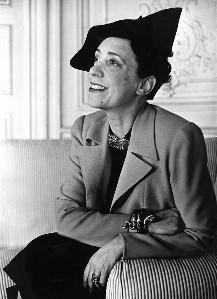
Elsa Schiaparelli
Shocking Pink
The Roman aristocrat who introduced surrealism to couture, zippers to evening wear, and shocking pink to the human eye.
Roman by birth; her surrealist house was based in Paris — included under Italy by origin, with a French working life.
Read full profile →
Emilio Pucci
Psychedelic silk-jersey prints
The Florentine marquis who flew for the Italian air force, skied for the Olympics, and built a jet-set empire on printed silk jersey.
Read full profile →
Miuccia Prada
The nylon Vela backpack (1984)
The Communist PhD from Milan who inherited a luggage shop, introduced nylon to luxury, and made ugliness the most valuable adjective in late-twentieth-century fashion.
Read full profile →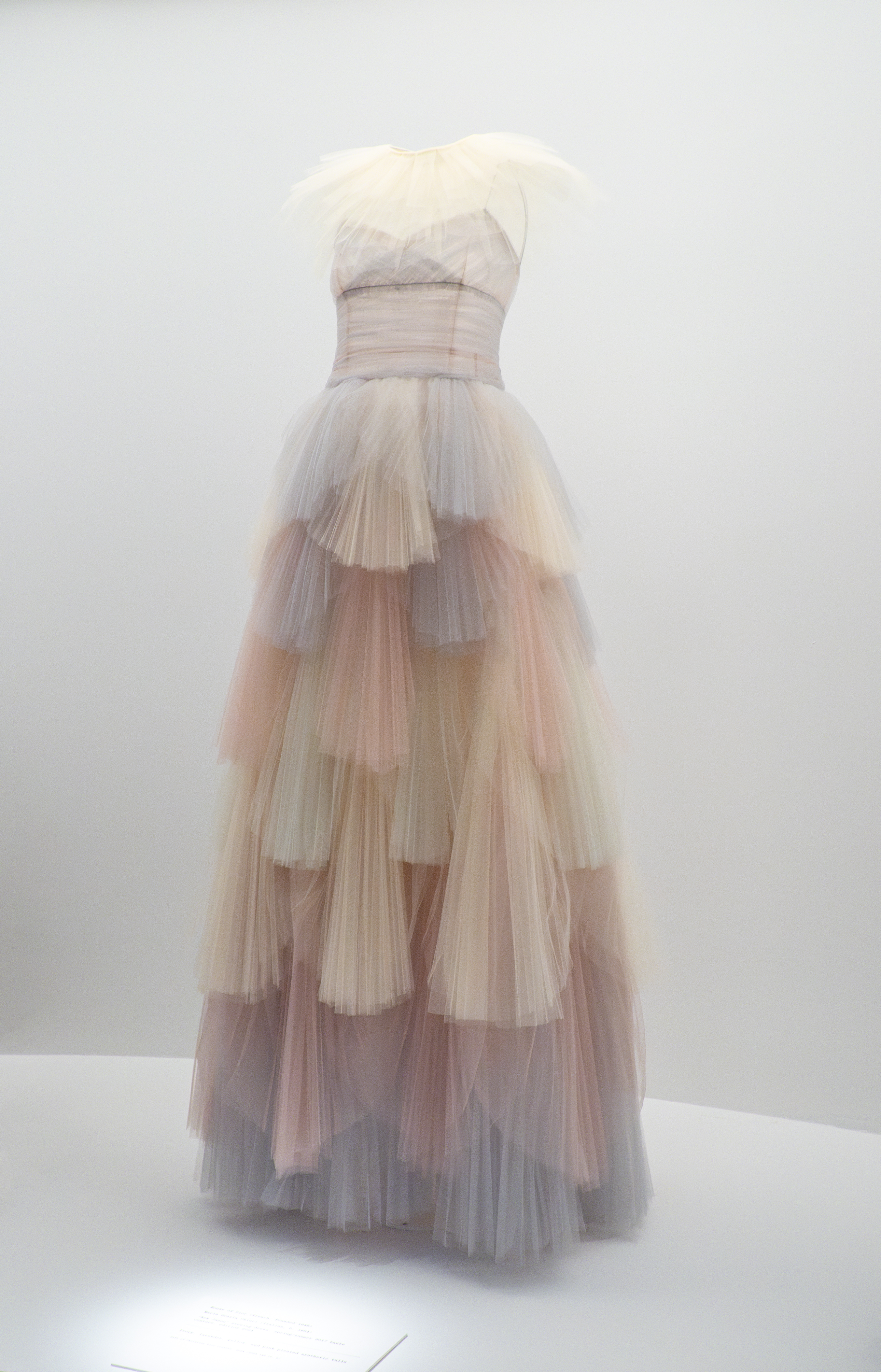
Maria Grazia Chiuri
First woman to lead Dior
The Roman designer who, in July 2016, became the first woman to lead Dior — and spent eight years using the house’s platform for overtly feminist couture.
Read full profile →
Pierpaolo Piccioli
Valentino solo couture decade (2016–2024)
The designer who took sole creative direction of Valentino in 2016 and produced, over eight years, the most romantically serious couture on the Paris calendar.
Read full profile →
Riccardo Tisci
Goth-streetwear Givenchy
The designer who merged couture with Rottweiler-print streetwear at Givenchy and made the house, for twelve years, the most culturally central couture label of the 2010s.
Read full profile →