The Aesthetic Movement: How Art-for-Art's-Sake Killed the Corset
A loose dress, a sunflower in a buttonhole, an Oscar Wilde quotation. The 1860s rebellion that invented bohemian style and broke the cage crinoline forever.
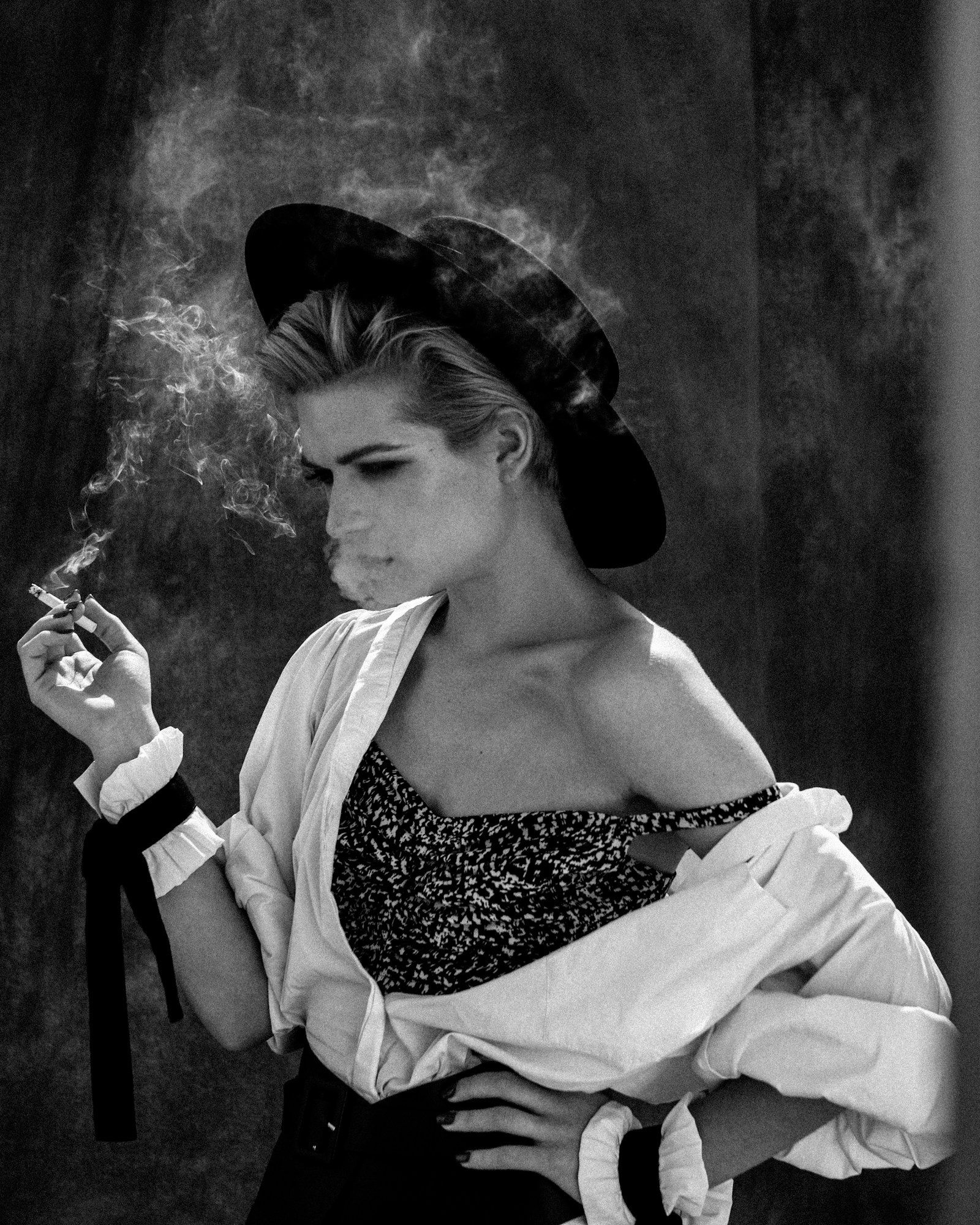
Victorian era, MDCCCXXXVII–MCMI
In 1881, Punch magazine ran a cartoon of a young woman in a loose, ungirdled gown, a single sunflower pinned to her breast, gazing at a teacup as though it contained the meaning of life. The caption was a sneer. The dress was a manifesto.
The Aesthetic Movement — in Britain from roughly 1860, in America by the 1880s — was the first organised rebellion against Victorian dress. It produced no single designer house, no signature silhouette in the modern sense, and no Paris couturier to canonise it. What it produced instead was an idea: that clothing was an art form, that beauty was its own justification, and that the cage crinoline, the steel corset, and the bustle were aesthetic crimes.
Within forty years that idea had — quietly, by way of dress reform societies, William Morris textiles, Liberty of London's tea-gowns, and the cumulative weight of a generation of women who simply refused to wear corsets — ended the Victorian silhouette altogether. Coco Chanel often gets the credit. The Aesthetes had been there sixty years earlier.
Origins
The movement began as a literary and visual one before it touched cloth. The Pre-Raphaelite Brotherhood, founded in 1848 by Dante Gabriel Rossetti, John Everett Millais, and William Holman Hunt, painted women in flowing, medieval-inflected gowns at a moment when actual women were trussed into hoops and whalebone. Their muses — Elizabeth Siddal, Jane Morris, Fanny Cornforth — began wearing the dresses they were painted in. Loose at the waist. Trailing at the hem. Dyed in colours unobtainable on the high street: peacock blue, sage green, terracotta, dusty rose.
By the 1860s a small but visible coterie of British writers, artists, and their wives had organised this into a position. The poet Algernon Charles Swinburne preached l'art pour l'art — art for art's sake. The critic Walter Pater, in his 1873 Studies in the History of the Renaissance, made a near-religious case for beauty as the highest good. William Morris founded a firm — Morris, Marshall, Faulkner & Co. — that produced wallpapers, fabrics, and embroideries on hand-block-printed lines, refusing the synthetic dyes and machine processes of industrial Britain.
Have nothing in your house that you do not know to be useful, or believe to be beautiful. — William Morris, 1880
In 1875, Arthur Lasenby Liberty opened a small Regent Street shop selling imported Japanese silks, Indian muslins, and — critically — a line of unstructured "art dresses" cut from Morris's prints. Liberty of London, as it became, was for forty years the world's only retail outlet specifically dedicated to dress reform.
The Style
The Aesthetic dress had four deviations from its Victorian contemporary, and each was radical.
It was uncorseted. Not loosely corseted; not corseted in front only; uncorseted. The waist was indicated by a soft sash, often of contrasting silk, or by gathers under the bust in the medieval cotehardie style. To Victorian eyes, this read as either pregnancy or immorality.
It was made of "art" fabrics — Morris chintzes, Indian block-prints, Japanese stencil-dyed cottons, hand-loomed Welsh flannels. These were not the satins and figured silks of bourgeois respectability. They were textiles with visible weave and irregular dye, prized precisely for the marks of the human hand.
It was archaic in cut. Sleeves puffed at the shoulder and tapered to the wrist (the medieval gigot), or hung in trailing points. Bodices laced or buttoned in the front like a Renaissance kirtle. Trains gathered behind in soft folds rather than the architectural cascade of a Worth bustle.
And it was coloured wrong. The high-Victorian palette ran to magenta, emerald, royal blue — the new aniline dyes patented in the 1850s, garish and chemical. Aesthetic dress used vegetable dyes: madder, indigo, weld, walnut. The result was a softer, more variable spectrum: terracotta, peacock teal, sage, art yellow (a kind of mustard), dusty rose. Punch mocked this as "greenery-yallery" — a sneer that, by the 1890s, was a brand.
The single most famous Aesthetic garment was the tea-gown: a loose, trailing house-dress worn at home for receiving guests, requiring no corset and no maid to lace it. Liberty's tea-gowns sold by the tens of thousands. By the 1900s the silhouette had migrated into dinner gowns and walking dresses, and the corset had begun — quietly, in the wardrobes of educated women — to disappear.
Cultural Context
The Aesthetic Movement was not a fashion phenomenon in isolation. It rode three larger currents.
The first was dress reform as a public-health argument. From the 1860s onward, doctors began publishing studies on the medical damage caused by tight-lacing: displaced organs, fainting, restricted breathing, miscarriage. The American physician Susan Anderson and the German doctor Gustav Jaeger independently advocated loose, woollen, "rational" clothing. Aesthetic dress provided an aesthetic vocabulary for an argument that, on its own, sounded merely medical.
The second was the women's suffrage movement. The British Women's Franchise League formed in 1889; the National Union of Women's Suffrage Societies in 1897. Suffragists overwhelmingly wore Aesthetic and Reform dress. The connection was not coincidental: a body that could not breathe could not march, and a wardrobe that required a maid could not be worn by a woman who lived alone or worked.
The third was Japonisme. The opening of Japan to Western trade in 1854 flooded London and Paris with kimonos, prints, lacquer, and porcelain. The kimono, in particular, was a revelation: a garment with no waist, no construction beneath, falling in clean planes from the shoulder. Whistler painted his mistresses in kimonos in the 1860s. By 1875, a Liberty tea-gown's unstructured silhouette was, essentially, a Western adaptation of the kosode.
Industrial Britain, in other words, was the conditioning context. The Aesthetes hated factories — hated the synthetic dyes, the powered looms, the "shoddy" of recycled wool, the cheapening of decoration. Their dress argued, by the visible irregularity of its weave and the slow vegetable depth of its dye, that a textile made by a person was a textile worth wearing.
Key Figures
The movement's loudest spokesman was Oscar Wilde, who in 1882 toured the United States in a costume that included velvet knee-breeches, silk stockings, a soft turn-down collar, and a sunflower. He delivered a lecture titled The English Renaissance of Art in fifty cities, often to mocking newspaper coverage. Within five years his costume had been copied by aesthetes from Boston to San Francisco; by 1900 the soft collar had replaced the stiff one in mainstream menswear.
Its visual codifiers were the Pre-Raphaelite painters and their muses — Rossetti, Millais, Burne-Jones, and the women who modelled, married, and dressed for them. Jane Morris in particular, photographed and painted endlessly in unstructured gowns of her own design, was the first "It girl" of art dress.
Its commercial engine was Liberty of London under Arthur Lasenby Liberty, which by the 1890s was selling tea-gowns to a clientele that included Sarah Bernhardt, Ellen Terry, and the Empress of Japan.
And its most enduring textile authority was William Morris, whose floral patterns — Strawberry Thief (1883), Pimpernel, Willow Bough — are still in continuous production at Morris & Co. today, 140 years on.
Legacy
The Aesthetic Movement was, by 1900, no longer a movement. It had won. The tea-gown was a mainstream garment. The corset was on a slow retreat that Paul Poiret, in 1908, would convert into a rout. Liberty's printed cottons were sold by Selfridge's and Marshall Field's. William Morris's wallpapers were on the walls of every aspirational drawing room from Surrey to Saint Louis.
The pioneers of art dress are now indistinguishable from the women they once shocked. — Vogue, 1923, on the death of Jane Morris
What it left behind was the concept that clothing could be an art object — that the materials, hand, and aesthetic judgment of its making mattered as much as its silhouette. This is the line that runs straight from the Aesthetes through Mariano Fortuny's Delphos gown of 1907, through Madeleine Vionnet's bias-cut, through the dress reform of the 1920s flapper, and into the deconstructed couture of Rei Kawakubo and Yohji Yamamoto a hundred and twenty years later.
It also produced — and this is harder to historicise — the bohemian. The art-school-trained, plant-print-wearing, hand-dyed-linen-loving figure who appears in Bloomsbury photographs of the 1910s, in the Greenwich Village portraits of the 1920s, in Joan Baez's wardrobe in 1962, in the Coachella crowd today. That figure's grandmother was an Aesthete. She wore loose Liberty cotton and a sunflower, and she meant it as a politics.
Related Reading
- Charles Frederick Worth — the structured Parisian couturier the Aesthetes defined themselves against.
- Mariano Fortuny y Madrazo — the Venetian polymath whose pleated Delphos gown of 1907 is the direct descendant of art dress.
- Madeleine Vionnet — the Burgundian seamstress whose bias-cut completed the project of removing structure from the female silhouette.
- The Victorian Era — the rigid context against which all of this was a rebellion.
Sources & Further Reading
- Kirsten Hartvig, The Aesthetic Movement (V&A Publishing, 2011).
- Stella Mary Newton, Health, Art and Reason: Dress Reformers of the 19th Century (1974).
- Patricia Cunningham, Reforming Women's Fashion, 1850–1920 (Kent State University Press, 2003).
- The William Morris Gallery, Walthamstow — permanent collection.
- Liberty of London archives, available by appointment.
Anaya Deshmukh
Fashion historian and essayist based in Delhi. Former curator at the Museum of Costume, her work traces the social lives of garments across two centuries.
Related Dispatches

Streetwear: How a New York Skate Shop Conquered Paris Fashion
A graphic tee from Lafayette Street, a hoodie from Harajuku, a sneaker drop announced on Instagram. The forty-year migration of skate-and-hip-hop dressing from subculture to luxury runway.
Minimalism: Why 1990s Restraint Still Defines Luxury Today
A bias-cut slip in undyed silk, a sleeveless shift in undyed wool, a bag with no logo at all. The decade that decided that subtraction was a luxury proposition — and was right.

Grunge: The Collection That Got Marc Jacobs Fired in 1992
A flannel shirt from a thrift shop, a slip dress over a Tee, a pair of Doc Martens. The Seattle-imported anti-glamour that ended one designer’s job at Perry Ellis and reordered fashion for a decade.
Readers’ Letters
Submissions are moderated, as in any decent publication.
No letters received yet. Yours may be the first.