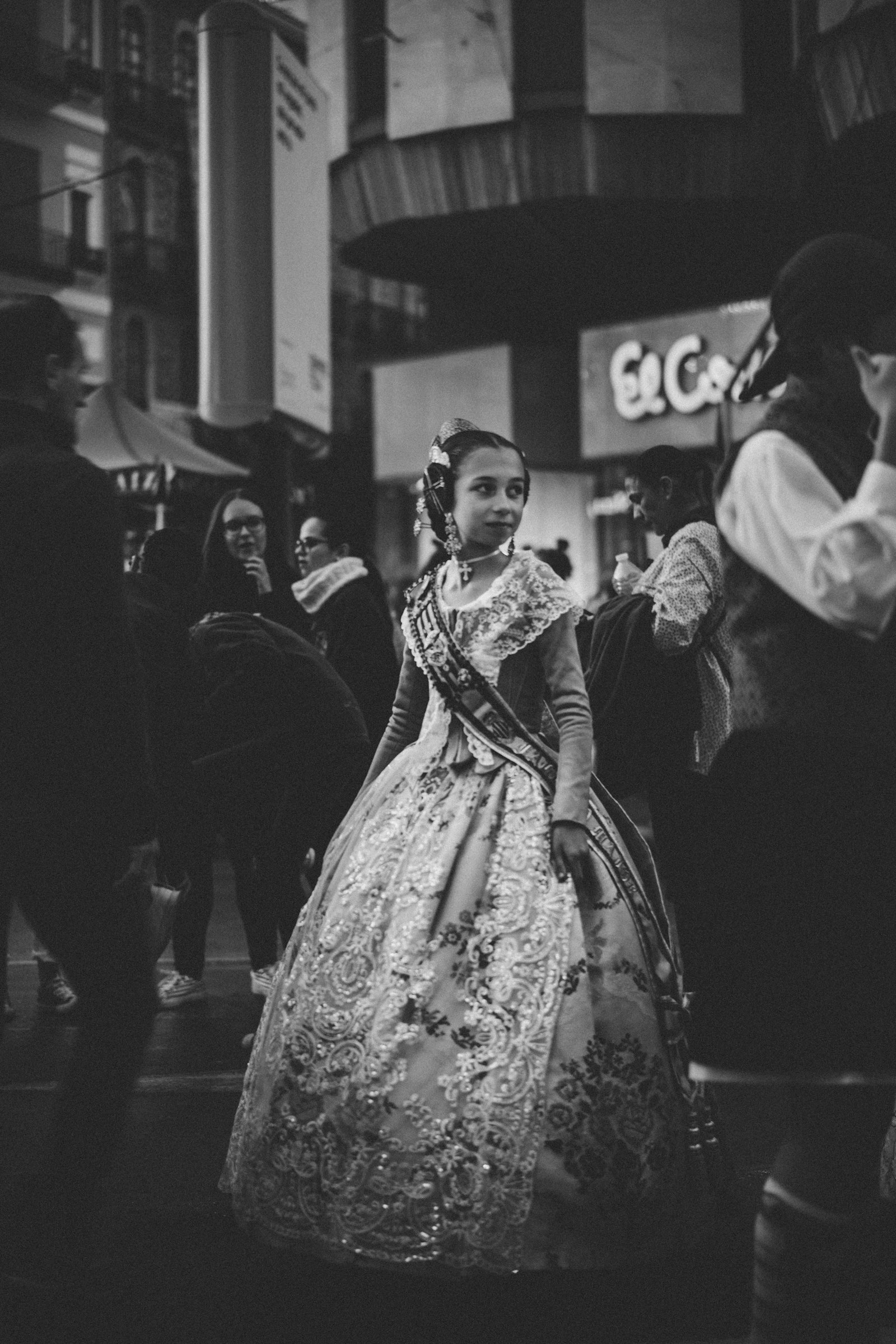
Spain
Volume, drama, and tradition.
Spain's fashion history is, in a sense, one man's: Cristóbal Balenciaga, the Basque couturier whom Christian Dior himself called 'the master of us all.' But the country also gave the modern world its most dominant fast-fashion company (Zara, 1975) and, via Loewe under Jonathan Anderson, one of its most intellectually ambitious contemporary luxury houses. Spain's contribution to dress is exceptionally polarised: the most technical couture of the twentieth century at one end, the most industrial ready-to-wear at the other.
The Master of Us All
Spain's fashion history has two poles, and for most of the twentieth century they did not touch. At one end, the most technical haute couture ever produced. At the other, a country of provincial dressmakers, inherited regional costume, and no national ready-to-wear industry. The modern bridge between them — the pret-a-porter economy that would eventually make Spanish clothing dominant in Europe — did not exist until the 1970s.
The couture pole was, and remains, almost entirely the work of one man. Cristóbal Balenciaga was born in 1895 in Getaria, a fishing village on the Basque coast, to a seamstress mother and a fisherman father. By the age of twelve he was copying, at his mother's instruction, a Madrid-made couture suit for the local Marquesa de Casa Torres; by twenty-two he had opened his own couture house in San Sebastián under the patronage of Queen Maria Cristina. The Spanish Civil War drove him to Paris in 1937, where, at 10 Avenue George V, he established the atelier that would define the technical standard of twentieth-century couture.
The Balenciaga Architecture
What Balenciaga did in Paris between 1937 and 1968 has never been surpassed. He was, unlike nearly every other couturier in the building, a cutter himself — he could draft, baste, and sew every garment he designed, and his ateliers were organised around his personal technical methods. The sack dress (1957), the cocoon coat (1957), the baby doll (1958), and the empire-line wedding dress that closed his 1968 final collection — all were the work of a designer who understood three-dimensional volume in ways the rest of the profession was still drafting on paper.
Christian Dior, his great rival, called him "the master of us all." Hubert de Givenchy, who trained in his Paris atelier, said he had never seen another couturier work with Balenciaga's level of technical authority. When Balenciaga closed his house in 1968 — refusing to participate in the emerging ready-to-wear economy he considered a vulgarisation — he did so by announcing, in a single letter to the clients, that the house was finished. There was no retrospective, no last collection, no sale. The Maison Balenciaga reopened in 1987 under a different creative team; today it is run by Demna.
Rabanne, and the Space Age
The second Spanish voice in twentieth-century Paris was Paco Rabanne, born Francisco Rabaneda Cuervo in San Sebastián in 1934, the son of Balenciaga's head seamstress. Rabanne's 1966 collection, Twelve Unwearable Dresses in Contemporary Materials, replaced fabric with plastic paillettes and metal discs, and for the next decade he was the most radical material experimenter in European fashion. His 1968 chainmail minidress, worn by Jane Fonda in Barbarella, remains the defining image of Spanish futurism.
Zara and the Industrial Revolution
The contemporary Spanish story is a very different one. In 1975, a textile tradesman named Amancio Ortega opened a small shop in A Coruña, Galicia, and called it Zorba after the 1964 film — quickly rebranded Zara after the chain across the street proved to share the name. By 1985, Zara had twenty stores across Spain. By 2000, it was the largest fashion chain in Europe. Today Inditex — Zara's parent — is the largest fashion retailer on Earth by revenue, and Ortega, at various points in the 2010s, was the second-wealthiest individual alive.
Zara's model — a two-week design-to-shelf cycle, aggressive copying of the Paris calendar, high-volume low-margin retail — effectively invented modern fast fashion. It is, culturally, the opposite of Balenciaga's proposition in every respect. Spain is the only European country that has produced both.
The Contemporary Moment
Spanish contemporary fashion is, outside the Inditex empire, largely a Madrid phenomenon. Loewe, the 1846 Madrid leather house, was revitalised after 2013 by the Northern Irish designer Jonathan Anderson into one of the most intellectually engaged luxury brands in Europe. Smaller houses — Delpozo, Palomo Spain, Leandro Cano — maintain the Spanish tradition of dramatic silhouette and elaborate craft. The country produces, still, less fashion than Italy or France by volume, but it retains the technical inheritance from Balenciaga and the commercial reach of Zara. No European country operates across a wider range.
Spain’s Designers, in Order of Arrival
Reading from past to present, with cultural context interleaved between the portraits.
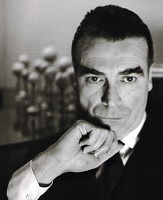
Cristóbal Balenciaga
The tunic dress (1955)
The master. The Basque fisherman’s son who taught the postwar couture its structure, and whom Dior called "the couturier of us all."
Basque Spanish; his couture house was established in San Sebastián before moving to Paris in 1937.
Read full profile →