Germany
Functional minimalism.
German fashion's great contribution is the Bauhaus aesthetic applied to dress — functional, engineered, stripped of decoration. Jil Sander reinvented European minimalism in the 1980s; Karl Lagerfeld ran Chanel for thirty-six years; Helmut Lang (Austrian, but culturally grouped with the Germanic tradition) defined 1990s cool. Hugo Boss, by revenue, is one of Europe's largest fashion businesses. What unites the German proposition across a century is a refusal of ornament.
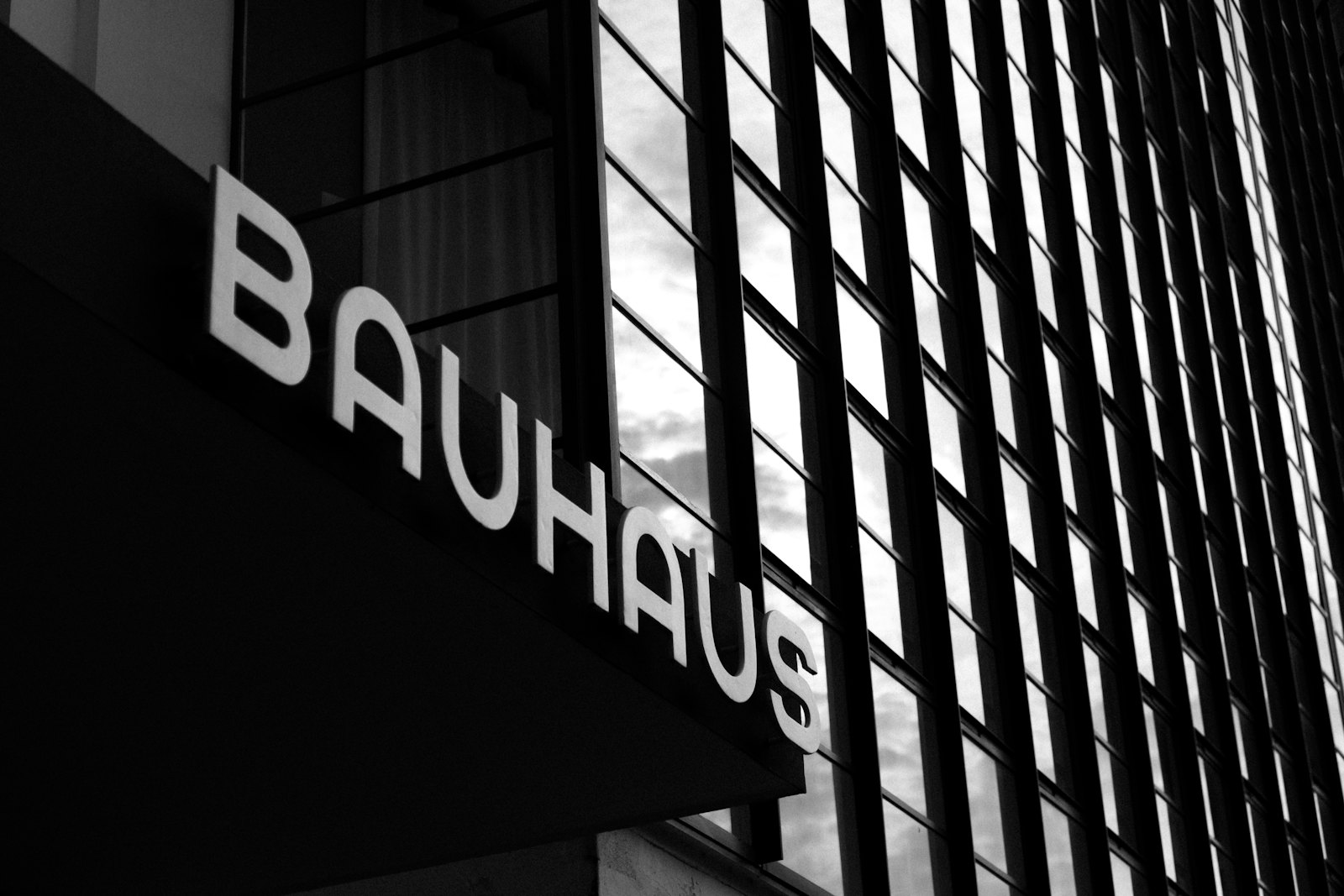
The Bauhaus Inheritance
German fashion is, in a way that French or Italian fashion is not, a continuation of a design philosophy rather than a couture tradition. The country had no nineteenth-century equivalent to Worth, no 1920s equivalent to Chanel, no post-war equivalent to Dior. What it had instead was the Bauhaus — the 1919–1933 Weimar–Dessau–Berlin school that taught, across a fourteen-year run cut short by the Nazi seizure of the building in 1933, that design should be functional, industrial, unadorned, and democratic. Gropius, Moholy-Nagy, Breuer, Kandinsky, and the others were not fashion designers. But the aesthetic they argued for — the tubular steel chair, the flat-roofed building, the typography stripped of decoration — became, within a generation, the foundational aesthetic of German applied design.
When German fashion emerged as a serious international proposition in the late twentieth century, it did so almost entirely in the Bauhaus tradition. There is a direct line from the 1925 Breuer Wassily chair to the 1985 Jil Sander black cashmere coat. Both are, in their respective materials, the same proposition: form stripped to its functional minimum, ornament abolished, the user's body and the object held in a clean geometric relationship.
Jil Sander and the Minimalist Foundation
Jil Sander — born Heidemarie Jiline Sander in Wesselburen, northern Germany, in 1943 — opened her first Hamburg boutique in 1968 and launched her own collection in 1973. For the next thirty years she produced what was, by common agreement in the industry, the most severe and intellectually consistent womenswear in Europe. A Jil Sander collection contained fifteen pieces, none of them decorated, all of them in materials that cost several times the average. The colours were black, white, grey, cream, and stone. The cut was architectural. The brand had no logo.
By the mid-1990s Sander's aesthetic had absorbed most of European minimalism into its gravitational field. Helmut Lang (Austrian, but trained in a Germanic sensibility and grouped, throughout his career, with Sander), Miuccia Prada in her first Prada womenswear collection in 1988, and a host of younger Paris and Milan houses all owed their vocabulary to what Sander had established. When the house was sold to Prada Group in 1999, Sander herself resigned within months, citing creative disagreement. The house passed to Raf Simons in 2005, to Lucie and Luke Meier in 2017, and back to Simons (briefly) in subsequent years — always within the minimalist vocabulary that Sander had defined.
Karl Lagerfeld and the Paris German
The other German of international consequence, Karl Lagerfeld, left Germany at twenty and lived in Paris for the subsequent sixty-five years. He worked at Balmain, Patou, Chloé, and Fendi before assuming creative direction at Chanel in 1983. The thirty-six-year Chanel tenure that followed is the longest creative directorship in the history of any major French couture house, and Lagerfeld — even after a lifetime in Paris — retained throughout what the French press consistently identified as a Germanic sensibility: a capacity for work that bordered on the industrial, a refusal of sentimentality, a designer's eye that treated every show as a separate engineering problem to be solved.
He was, simultaneously, the creative director of Chanel, Fendi, and his own eponymous house for most of the 1990s and 2000s. No other designer in modern fashion has held three major directorships at once for as long.
Hugo Boss, Adidas, and the Industrial Base
Parallel to the couture story is the German industrial story. Hugo Boss, founded in Metzingen in 1924, survived its compromised Nazi-era production history to become, from the 1980s onward, one of the largest menswear businesses in Europe. Adidas, founded in 1949 in Herzogenaurach, and its offshoot Puma, are two of the three largest athletic-footwear companies in the world. Escada, Wolford (Austrian but often grouped with Germany), and MCM round out the mid-market German brand landscape. The country does not have a Paris or Milan fashion week of comparable international weight, but it produces more fashion at scale than most of Europe.
The Berlin Moment
The twenty-first century has added a second German fashion proposition: Berlin. The city's club economy, its cheap studio rents, its status as the European capital of techno and electronic music, have all supported a generation of Berlin-based designers — Lutz Huelle, Don't Shoot the Messengers, Perret Schaad, GmbH, Ottolinger — whose work reads as the post-minimalist response to the Sander tradition. Berlin fashion is youth-led, subculture-rooted, and indifferent to the heritage-luxury game. It is, for the first time in a century, giving Germany a fashion city the world watches.
Germany’s Designers, in Order of Arrival
Reading from past to present, with cultural context interleaved between the portraits.

Karl Lagerfeld
54 years at Fendi
The Hamburg prodigy who ran two luxury houses for three decades apiece, produced fifteen collections a year, and died at the drawing board.
German by birth; chief creative force at Chanel (Paris) and Fendi (Rome) for decades.
Read full profile →
Helmut Lang
1990s minimalism
The Vienna self-taught tailor whose minimalist, deconstructed tailoring defined the 1990s silhouette — and who, in 2005, left fashion to become a sculptor.
Austrian; his conceptual minimalism is usually grouped with the Germanic design tradition.
Read full profile →