The Sari Across Centuries
Six yards of unstitched cloth, worn continuously on the subcontinent for three millennia. A history of the longest-lived garment in the world.
Victorian era, MDCCCXXXVII–MCMI
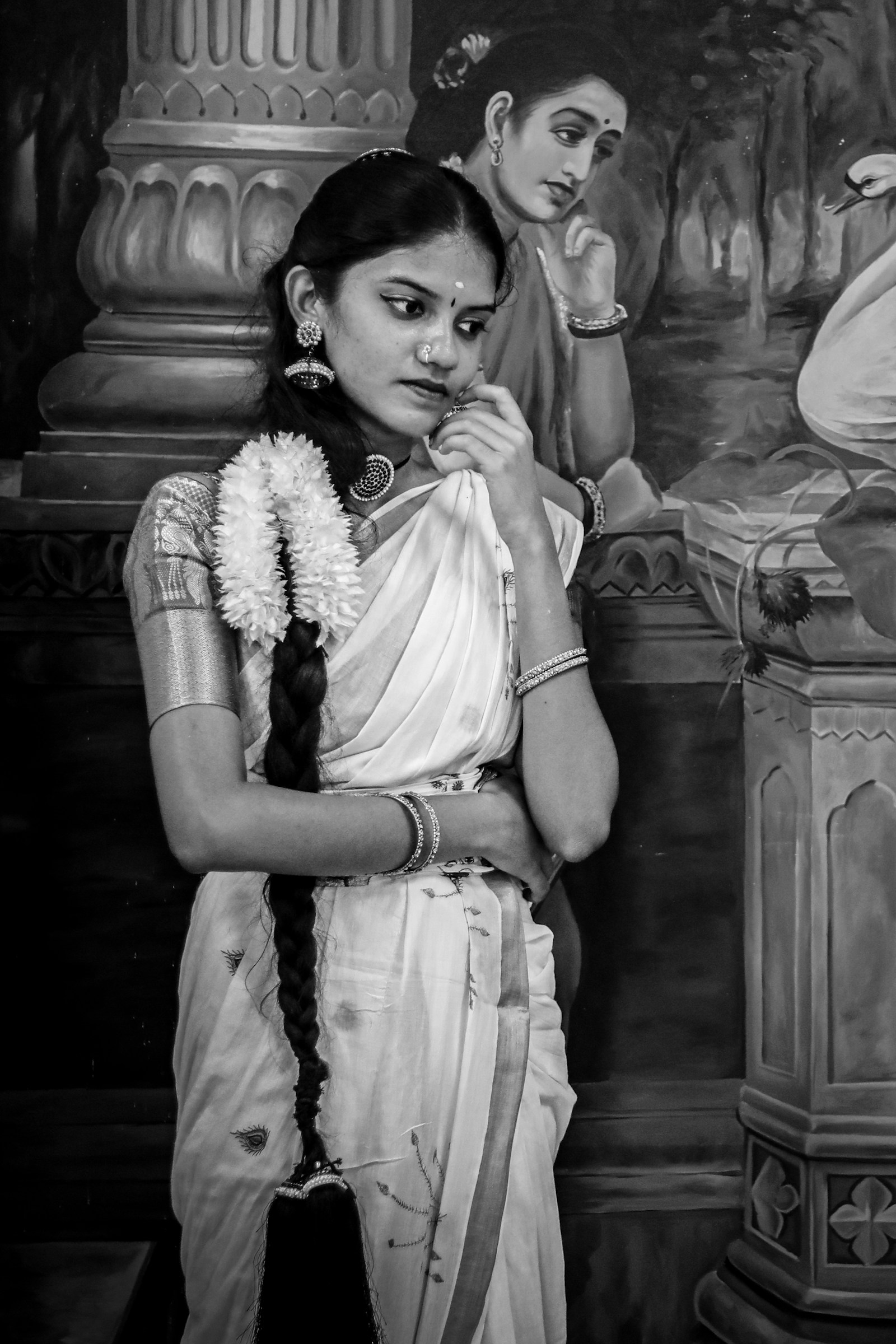
The sari is the longest-lived garment still in daily use. Its earliest references are in the Vedic literature of roughly 1500 BCE, which describes an unstitched length of cotton, wrapped around the waist and draped over a shoulder. Terracotta figures from the Maurya and Sunga periods (c. 300 BCE) confirm the draping. It is probable that versions of the garment predate the written record by another thousand years.
What has changed, across that history, is not the sari but the body underneath.
The Mathematics of Drape
A standard modern sari is between five and nine yards long, and forty-eight inches wide. It is pleated at the waist — conventionally seven pleats — tucked into an underskirt, and passed over the left shoulder. The shoulder-drape, called the pallu, is the most expressive element, the piece traditionally most heavily embroidered and most frequently adjusted.
There are, by the count of the Mumbai textile historian Rta Kapur Chishti, 108 regional draping styles currently in use on the subcontinent. This count, she notes, excludes extinct styles and new ones invented by individual designers within the past forty years.
A sari is unstitched but not unordered. The order is in the drape. — Rta Kapur Chishti
The Blouse, and Empire
The choli blouse worn beneath the sari is a recent imposition. Before the mid-19th century, most women on the subcontinent wore the sari directly over the skin or over a simple breast-band. The modern tailored blouse was introduced — and, at high-Victorian social functions, enforced — by the British Raj, which found the pre-colonial form of the garment unacceptable for official engagement.
This is the moment, arguably, at which the sari became a colonial object. The act of draping one now involves, unavoidably, negotiation with a 19th-century administrative intervention.
Contemporary Draping
The sari was, through most of the 20th century, a garment associated with older women. In the cities of the 1990s it began to return, as a specifically chosen garment rather than a default one — worn, often, by designers and their clients as a statement against the homogenising Western wardrobe.
The Sari Project, an archival initiative launched in Delhi in 2017, has collected over two thousand regional drapes on video. Many of these drapes, the project’s curators note, were learned, in the past fifteen years, by the granddaughters of women who had stopped wearing them.
The sari, in other words, is a garment whose survival depends on a deliberate re-acquisition. Which is to say — and this is unusual for any garment — that its future is not automatic. It must be, with each generation, chosen.

Anaya Deshmukh
Fashion historian and essayist based in Delhi. Former curator at the Museum of Costume, her work traces the social lives of garments across two centuries.
Related Dispatches

Streetwear: How a New York Skate Shop Conquered Paris Fashion
A graphic tee from Lafayette Street, a hoodie from Harajuku, a sneaker drop announced on Instagram. The forty-year migration of skate-and-hip-hop dressing from subculture to luxury runway.

Minimalism: Why 1990s Restraint Still Defines Luxury Today
A bias-cut slip in undyed silk, a sleeveless shift in undyed wool, a bag with no logo at all. The decade that decided that subtraction was a luxury proposition — and was right.

Grunge: The Collection That Got Marc Jacobs Fired in 1992
A flannel shirt from a thrift shop, a slip dress over a Tee, a pair of Doc Martens. The Seattle-imported anti-glamour that ended one designer’s job at Perry Ellis and reordered fashion for a decade.
Readers’ Letters
Submissions are moderated, as in any decent publication.
No letters received yet. Yours may be the first.