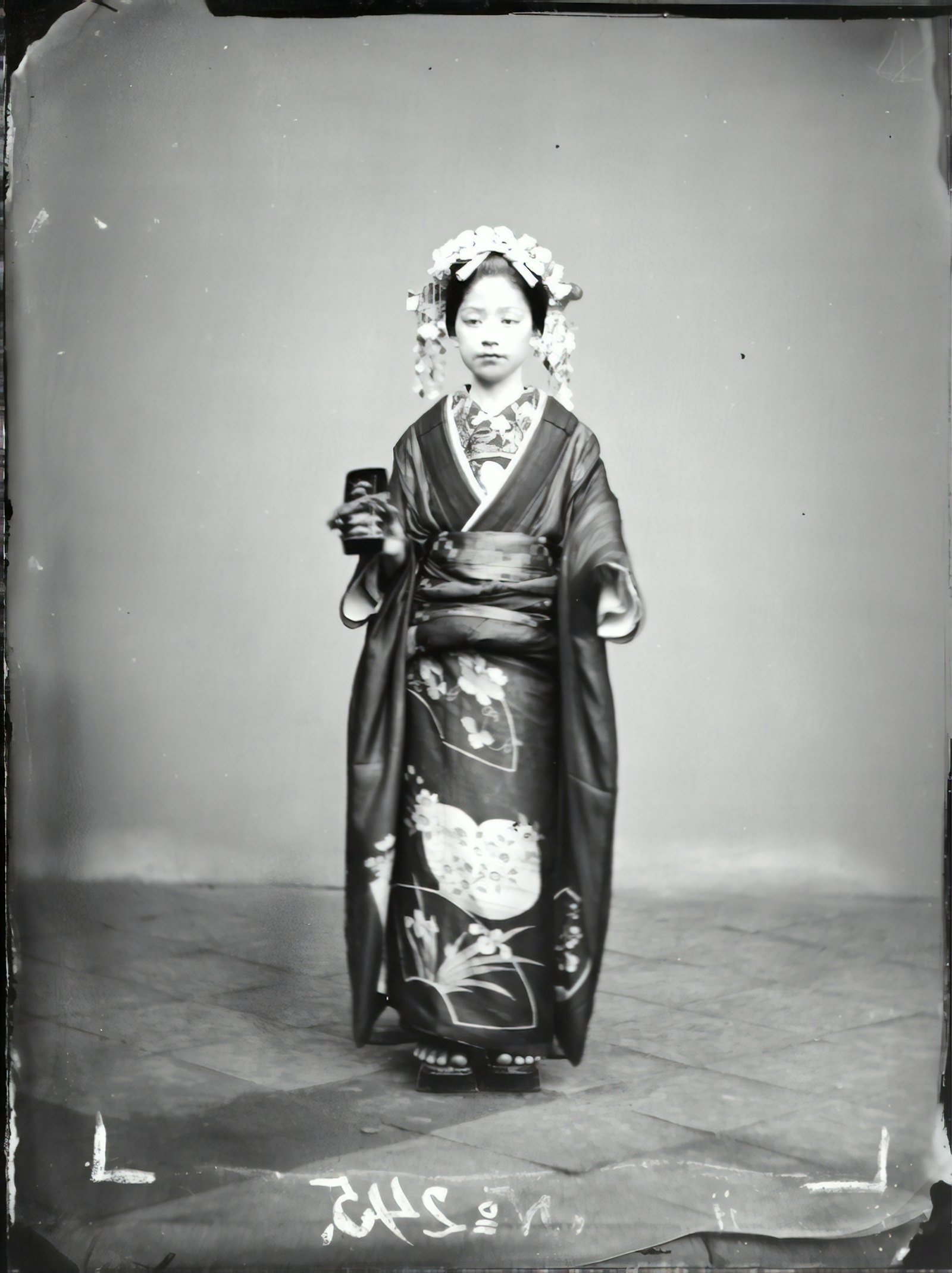
Japan
The anti-fashion revolution.
Japan did not enter Western fashion. It broke it. When Rei Kawakubo and Yohji Yamamoto showed in Paris in 1981, their black, asymmetric, deliberately unfinished garments were read by the French press as 'Hiroshima chic.' Within a decade they had rewritten the European vocabulary of tailoring, colour, and beauty itself.
The Anti-Fashion Revolution
For thirty years after the Second World War, Japanese fashion was organised around one idea: catching up with the West. Tokyo sent buyers to Paris, imported silhouettes, and manufactured them for the domestic market. The first serious Japanese designer to show abroad, Hanae Mori, worked inside the French system — she opened a Paris atelier in 1977 and was inducted into the Chambre Syndicale in 1977, the only Japanese member.
Kenzo Takada, who opened Jungle Jap in Paris in 1970, was the first to suggest that the exchange could run in the opposite direction. His collections used Japanese folk textiles, kimono cuts, and a riot of colour that Paris — still largely dressed in the Dior tradition — had not seen. By 1973 Kenzo was a Paris fixture. He proved that Japan could export, not only import.
1981: The Paris Debut
The revolution, however, arrived on 1 April 1981, when Rei Kawakubo (Comme des Garçons) and Yohji Yamamoto showed their first Paris collections. Both had been showing in Tokyo since the mid-1970s. Both had studied the European vocabulary intimately. Both, that day, rejected it.
The clothes were almost entirely black. They were oversized where European tailoring was fitted, asymmetric where it was symmetrical, distressed where it was pristine. The holes in the knit sweaters were not flaws but features. The hemlines were unfinished on purpose. The models wore no makeup. To a French press trained on Saint Laurent and Chanel, the collections read as a refusal of everything fashion was supposed to be — elegant, finished, flattering, feminine. Bernadine Morris of the New York Times called the work "disturbing." Women's Wear Daily called it "deliberately ugly." The now-infamous phrase "Hiroshima chic" appeared in the French press.
Within three years the collections were considered the most important new proposition in European fashion. The oversized black silhouette, the deconstructed seam, the exposed lining, the emphasis on fabric over body — all of it entered the mainstream European vocabulary. Martin Margiela, Ann Demeulemeester, Helmut Lang, Raf Simons — the entire 1990s conceptual movement in Europe traces its founding moment to April 1981.
Miyake and the Engineered Garment
Issey Miyake represented the third pillar of the Japanese Paris presence. Miyake had worked under Guy Laroche and Hubert de Givenchy in the 1960s before returning to Tokyo in 1970 and opening the Miyake Design Studio. Where Kawakubo and Yamamoto worked conceptually, Miyake worked technologically. His 1988 Pleats Please collection used an industrial pleating process — fabric pre-cut, sewn, then pressed between heated paper — that produced garments that were simultaneously high-concept and radically wearable. The 1999 A-POC (A Piece of Cloth) system, developed with the engineer Dai Fujiwara, produced an entire garment from a single length of cloth via precision knitting. Miyake, almost alone in his generation, made the argument that fashion was an engineering discipline.
The Contemporary Moment
Japan's twenty-first century fashion scene is split between the conceptual heritage (Comme des Garçons, Yohji, Junya Watanabe, Sacai) and the streetwear generation (Hiroshi Fujiwara, NBHD, WTAPS, UNDERCOVER, bape). Harajuku and Shibuya produced, in the 1990s and 2000s, the most internationally influential street fashion in the world — the Fruits magazine generation whose photographs reshaped European and American street style.
What defines Japanese fashion across both wings is its refusal of the French premise. Paris holds, implicitly, that a garment exists to flatter a body. Tokyo argues, persistently, that a garment exists for its own sake — an object, a proposition, a piece of cloth in space. The argument has been running since 1981. The garment industry is still absorbing it.
Japan’s Designers, in Order of Arrival
Reading from past to present, with cultural context interleaved between the portraits.

Hanae Mori
First Asian couturier admitted to the Chambre Syndicale (1977)
The Shimane-born designer who became, in 1977, the first Asian couturier admitted to the Paris Chambre Syndicale de la Haute Couture.
Read full profile →
Issey Miyake
Pleats Please (1993)
The Hiroshima survivor who treated clothing as an engineering problem, and designed the black mock-turtleneck Steve Jobs wore for thirteen years.
Read full profile →
Kenzo Takada
The first Japanese designer to show in Paris (1970)
The Hyōgo-born designer who bought a one-way ticket to Paris in 1965 and, five years later, became the first Japanese couturier to show there — in a shop named Jungle Jap.
Read full profile →
Rei Kawakubo
Destroy Lace (1982)
The Tokyo philosophy graduate who in 1982 walked into Paris with black, torn, asymmetric clothing — and rewrote the grammar of fashion.
Read full profile →
Yohji Yamamoto
Asymmetric oversized tailoring
The Tokyo tailor’s son who made black into a philosophy and turned oversized men’s tailoring into the standard grammar of European fashion.
Read full profile →