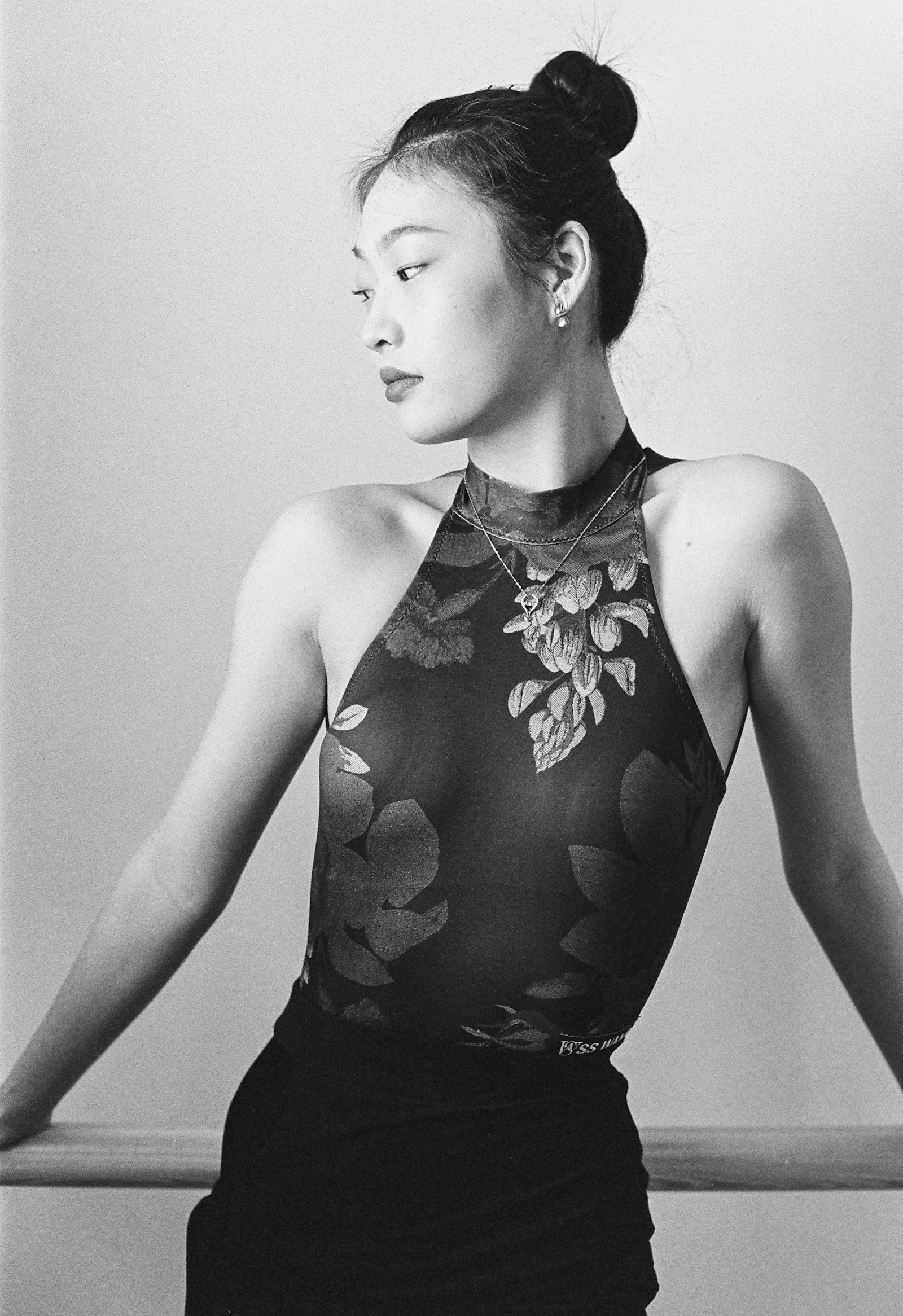
China
Heritage meets futurism.
Chinese fashion draws on the deepest continuous textile heritage in East Asia alongside Japan — silk, jacquard, embroidery, the four-thousand-year-old *hanfu* silhouette — reinterpreted by a contemporary Shanghai and Beijing generation. From Guo Pei's extravagant couture to Uma Wang's minimalist textile work to the Shanghai Fashion Week calendar launched in 2003, China is now, simultaneously, the world's largest fashion manufacturer, its largest luxury consumer, and a credible emerging fashion capital in its own right.
Four Thousand Years, with Interruptions
China has, alongside India and Japan, one of the three longest continuous textile traditions on Earth. Silk was cultivated in the Yellow River valley by approximately 3000 BCE; the Shiji (Records of the Grand Historian), composed around 100 BCE, already describes imperial-workshop production of figured brocades at a scale that would not be matched in Europe for another thousand years. The Silk Road — the name is a nineteenth-century European invention, but the phenomenon was real — carried Chinese silk westward for over a millennium as the most valuable commodity in Eurasian long-distance trade.
Every major Chinese dynasty developed a distinct court-dress aesthetic: the flowing hanfu of the Han and Tang, the rigid longpao dragon robe of the Ming, the fitted Manchu cheongsam that would become, under the Republic of China, the modern qipao. By 1900 the Chinese textile industry was, in absolute output, still the largest on Earth. Then the twentieth century intervened.
Shanghai 1920–1949: The Paris of the East
The first modern Chinese fashion capital was Shanghai between the two world wars. The city was, in the 1920s and 1930s, an international concession — French, British, American, and Japanese quarters operating alongside Chinese-governed districts — and its fashion economy reflected that cosmopolitanism. The qipao was modernised in the 1925 by Shanghai tailors into a form-fitting silhouette with side slits; by the early 1930s it was the defining womenswear of Chinese urban modernity. Shanghai produced, in this period, hundreds of small couture houses, cinema costumers, and named dressmakers.
The city's golden age ended with the 1937 Japanese invasion and definitively with the 1949 Communist victory. The qipao was effectively banned as bourgeois; private couture houses were nationalised or closed; the emerging Chinese fashion tradition was frozen for nearly forty years. For four decades, Chinese dress was the Mao suit.
The Reform Era
Deng Xiaoping's gaige kaifang reforms, beginning in 1978, slowly reopened the Chinese fashion market. Pierre Cardin staged the first foreign fashion show in Beijing in 1979 — a remarkable event: French couture models walking past Chairman Mao portraits in the Great Hall of the People. Through the 1980s and 1990s, Chinese domestic design re-emerged slowly, first as copying of international brands, then as original work. The government's 2003 decision to launch Shanghai Fashion Week was the formal acknowledgement that Chinese private fashion design was again a legitimate industry.
The first generation of Shanghai Fashion Week designers — Ma Ke (Exception de Mixmind), Wang Yiyang (Cabbage & Jooos), Uma Wang — produced work that was, deliberately, non-derivative of Western fashion. Ma Ke's collections used hand-woven textiles from rural Sichuan and Yunnan; Uma Wang worked with antique Chinese embroidery in distressed, oversized silhouettes. This was, explicitly, a rejection of the logo-luxury Chinese market that was simultaneously consuming the international luxury sector at unprecedented scale.
Guo Pei and the Rebirth of Couture
If Shanghai Fashion Week produced conceptual ready-to-wear, Beijing produced the renewal of Chinese couture. Guo Pei, born in 1967, trained at the Beijing No. 2 Light Industry University and founded Rose Studio in 1997. Her couture work draws explicitly on Chinese imperial-court embroidery traditions — the longpao, the Qing-dynasty mangfu — executed to a technical standard that no contemporary European atelier matches for hand-embroidery density. Her 2010 Magnificent Gold gown (fifty kilograms, five thousand hours of hand embroidery) entered the permanent collection of the Met Costume Institute in 2015 and was the defining image of China: Through the Looking Glass, the most-attended exhibition in the museum's history.
Guo Pei became, in 2015, a guest member of the Paris Chambre Syndicale — the first Chinese couturier so designated. She remains the only Chinese house shown on the official Paris couture calendar.
The Contemporary Moment
Chinese fashion in the 2020s operates at an unprecedented scale. China is the world's largest luxury consumer (approximately 35% of global luxury spending in 2023), the world's largest fashion manufacturer (approximately 40% of global textile output), and a credible emerging fashion capital in its own right. Shiatzy Chen (Taiwanese but operating across Greater China) is a fixture of the Paris calendar. Uma Wang, Masha Ma, Xander Zhou, and Feng Chen Wang show at Paris or London. Angel Chen has shown at Milan Fashion Week since 2017.
Parallel to this internationalising movement, a domestic hanfu revival has produced hundreds of Chinese brands — Han Shang Hua Lian, Shi Yin, Ming Hua Tang — reviving Tang, Ming, and Qing dynasty silhouettes for contemporary everyday wear. This is the first time in seventy years that Chinese traditional dress has a commercially viable contemporary form. It may, in the long run, prove the most important Chinese fashion development of the century.
China’s Designers, in Order of Arrival
Reading from past to present, with cultural context interleaved between the portraits.
No designers catalogued here yet — dispatches forthcoming.