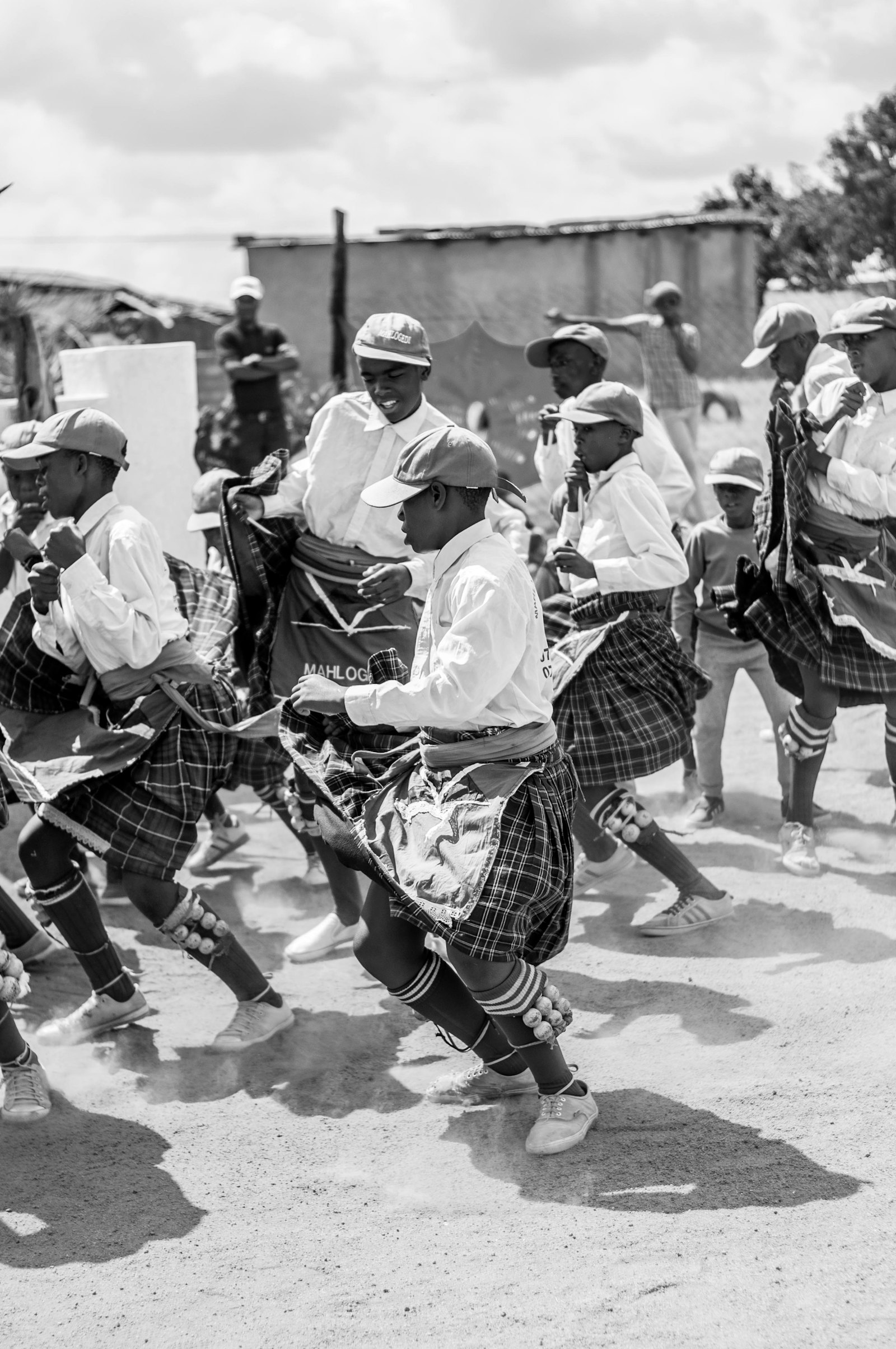
South Africa
Heritage and modernity.
South African fashion is the intellectual counterpart to the Nigerian scene. Where Lagos drives volume, Johannesburg and Cape Town produce concept. Thebe Magugu — 2019 LVMH Prize winner, the first sub-Saharan African to hold the honour — is the contemporary face, working alongside Laduma Ngxokolo's MaXhosa Xhosa-pattern knitwear, David Tlale's theatrical couture, and Marianne Fassler's forty-year-old Johannesburg atelier. The country punches well above its scale on the international calendar.
The Post-Apartheid Renaissance
South African fashion is, like almost every aspect of contemporary South African culture, a post-1994 story. The country emerged from the apartheid era — and from the international sanctions regime that had accompanied it — with a domestic textile industry but no international fashion presence, no design education of global calibre, and no access, for four decades, to the Paris and Milan retail circuits. The Mandela government's first decade was, across every creative sector, a reconstruction project. Fashion was no exception.
The inflection was Lucilla Booyzen's 1997 founding of South African Fashion Week in Johannesburg. SAFW was not, in its first years, a commercially significant event. But it provided, for the first time, a calendar that could introduce the post-isolation generation — designers like Stoned Cherrie (Nkhensani Nkosi), Marianne Fassler, and David Tlale — to the buyers, press, and retail infrastructure that had been inaccessible under apartheid. By 2005, SAFW was the oldest continuous African fashion week and the reference calendar for the entire SADC region.
Marianne Fassler and the Johannesburg School
The elder statewoman of contemporary South African fashion is Marianne Fassler, who opened her Johannesburg atelier in 1978. Fassler's work — a distinctive vocabulary of shweshwe indigo cotton, beadwork, and pan-African referencing — was developed entirely within the apartheid isolation and has operated since 1994 as a kind of continuity of local craft practice. Her Leopard Frock label remains, forty years on, the most-copied silhouette in Johannesburg ready-to-wear.
Parallel to Fassler, David Tlale (born 1975, Johannesburg) built his reputation from 2003 onward on theatrical, heavily embellished couture shows that were — among other things — the first openly camp South African fashion presentations. Tlale's shows on the Nelson Mandela Bridge (2011) and at the Johannesburg Stock Exchange (2014) reset what South African fashion-spectacle could look like. He remains the dominant South African designer by domestic retail footprint.
Laduma Ngxokolo and the Xhosa Revival
The single most influential contemporary South African fashion project is MaXhosa Africa, founded in 2012 by Laduma Ngxokolo, a Nelson Mandela University graduate whose undergraduate thesis had translated traditional Xhosa beadwork patterns into knitwear. Ngxokolo's work does what almost no other contemporary African fashion project manages: it produces a legible, saleable, internationally shippable garment — the MaXhosa jumper — that is specifically Xhosa in its visual vocabulary rather than pan-African or abstract.
The commercial success of MaXhosa (approximately US$10M annual revenue by 2022) demonstrated something that had been theoretical for decades: a specifically African visual tradition could scale as luxury knitwear if the design and production pipeline was correctly managed. Ngxokolo has since opened flagship stores in Cape Town, Johannesburg, and New York.
Thebe Magugu and the LVMH Moment
The designer who took South African fashion onto the Paris calendar decisively is Thebe Magugu, born in Kimberley in 1993 and a 2016 LISOF (Johannesburg) graduate. Magugu's 2019 LVMH Prize win — the first sub-Saharan African to hold the honour — was the moment the international luxury system formally acknowledged the country's contemporary fashion output. The prize carried a €300,000 cash award and a year's mentorship inside the LVMH houses; Magugu chose Dior and produced, in 2021, a significant collaboration with Maria Grazia Chiuri.
Magugu's work is, aesthetically, a distinctive proposition. His collections regularly cite South African political and social themes — the 2019 collection explored female intelligence officers in the apartheid security state; the 2021 collection was an explicit response to the gender-based violence crisis — in a visual language that is minimal, tailored, and intellectual rather than folkloric. He is, by common agreement among international fashion press, the most important sub-Saharan African designer currently working.
The Cape Town Counterpart
Separately from the Johannesburg establishment, Cape Town Fashion Week and the Cape Town design community have produced a distinct contemporary scene — Rich Mnisi, Sindiso Khumalo, Wanda Lephoto, Akedo — that tends toward the conceptual and the sustainably-sourced. Mnisi in particular has become, through his 2021 Dior collaboration (alongside Magugu's) and his 2023 Milan showing, a significant international presence.
The Contemporary Moment
South African fashion in the 2020s operates on two tracks: the commercial Johannesburg industry (Fassler, Tlale, Ngxokolo, Gert-Johan Coetzee) and the Paris-facing conceptual scene (Magugu, Mnisi, Wanda Lephoto). The country has, via the Magugu LVMH Prize and the steady European retail presence of MaXhosa, genuinely broken through. The question of whether South Africa can produce a house at scale — a MaXhosa of Zara proportions, or a Magugu who could run a major French heritage brand — is the open question of the 2030s. For a country that had no international fashion presence thirty years ago, the trajectory is already remarkable.
South Africa’s Designers, in Order of Arrival
Reading from past to present, with cultural context interleaved between the portraits.
No designers catalogued here yet — dispatches forthcoming.